



TUCSON, Ariz. (KGUN) — An unexpected ingredient could be the key to making urban farming more local and less wasteful.
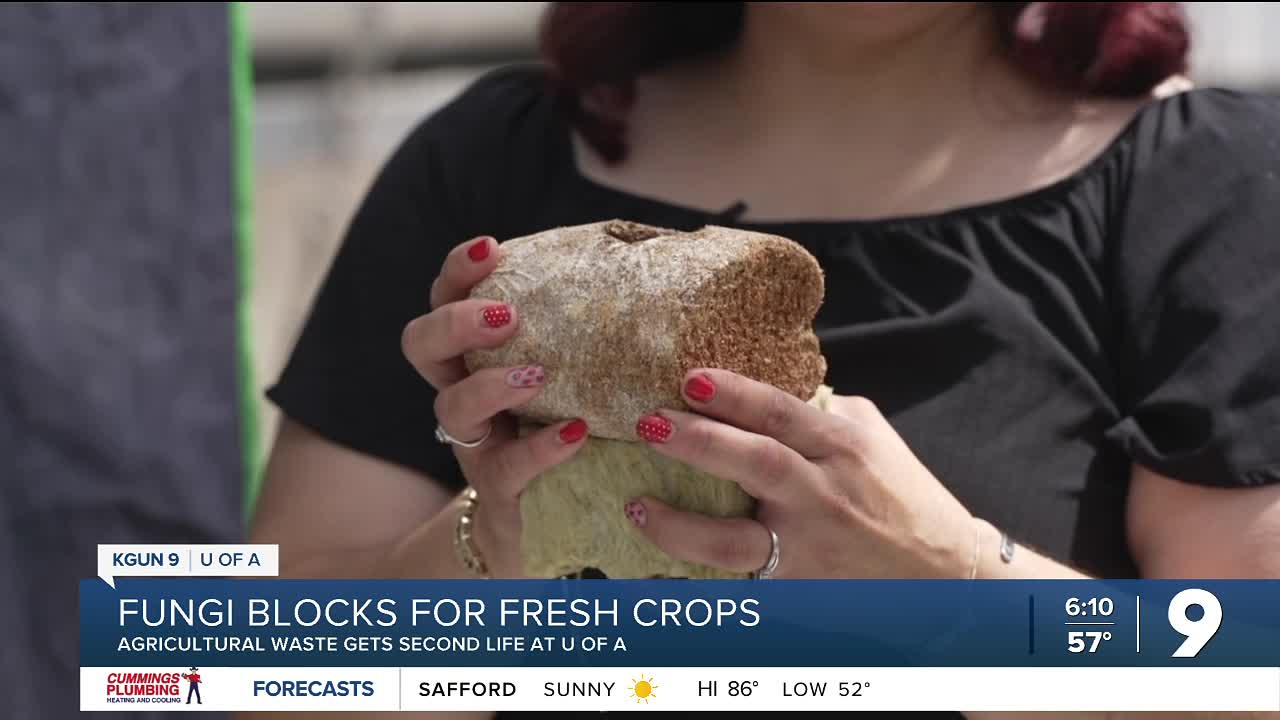
Students and faculty from the University of Arizona’s Controlled Environment Agriculture Center, or CEAC, are turning to mushrooms to grow food through their Fungi Blocks for the Fresh Crops Project.
Many of the plants inside CEAC greenhouses are cared for using hydroponics—nutrient-rich water instead of soil—inside blocks called rock wool slabs.
Though the blocks are small, easy to use and fairly easy to find, biosystems engineering research specialist Bree Gomez says there’s a downside: “they’re single-use materials. When the crop is done, that material gets disposed of.”
Using the University of Arizona’s campus sustainability fund, Gomez and others in the greenhouse found a way to solve that downside through natural materials they already had.
“Mushrooms in particular are experiencing a bit of a moment,” Gomez said. “The more we’re looking into mycology, mushrooms, the more uses, really fun uses we’re able to figure out.”
CEAC has no shortage of mushrooms. The center is home to natural students and researchers from many different disciplines, meaning their work often overlaps.
Graduate students Ashley McKinley—who studies hydroponics and helps run the teaching greenhouse—and Stacey Hinzman—who studies mycology, were able to use both disciplines for this project.
Mushrooms grow on blocks of substrate. After it’s harvested, the mushrooms leave behind a block of nutrients that’s usually composted. But that leftover block somewhat resembles the rock wool slabs already being used in the teaching greenhouse.
“If I have a mushroom farm, and I have all this spent mushroom substrate, why can’t I reuse it to grow something in my farm which can provide nutrition for my family, for my friends?” Hinzman said.
The leftover, or “spent” mushroom substrate, is ground up and used in a slab with other spent organic material, then fungi blocks with seeds are placed on top. Those blocks—also made of agricultural waste— are held together by mushroom mycelium acting as the glue.
That collection of agricultural waste ends up turning into tomatoes, cucumbers and peppers.
The project has been so successful so far that some graduate students—like McKinley— are incorporating the block into their own work.
“I would say the environmental conditions, coupled with the teaching greenhouse environmental conditions, coupled with the fungi block substrate, have produced noticeably, like visibly larger fruits,” she said.
----
STAY IN TOUCH WITH US ANYTIME, ANYWHERE

