

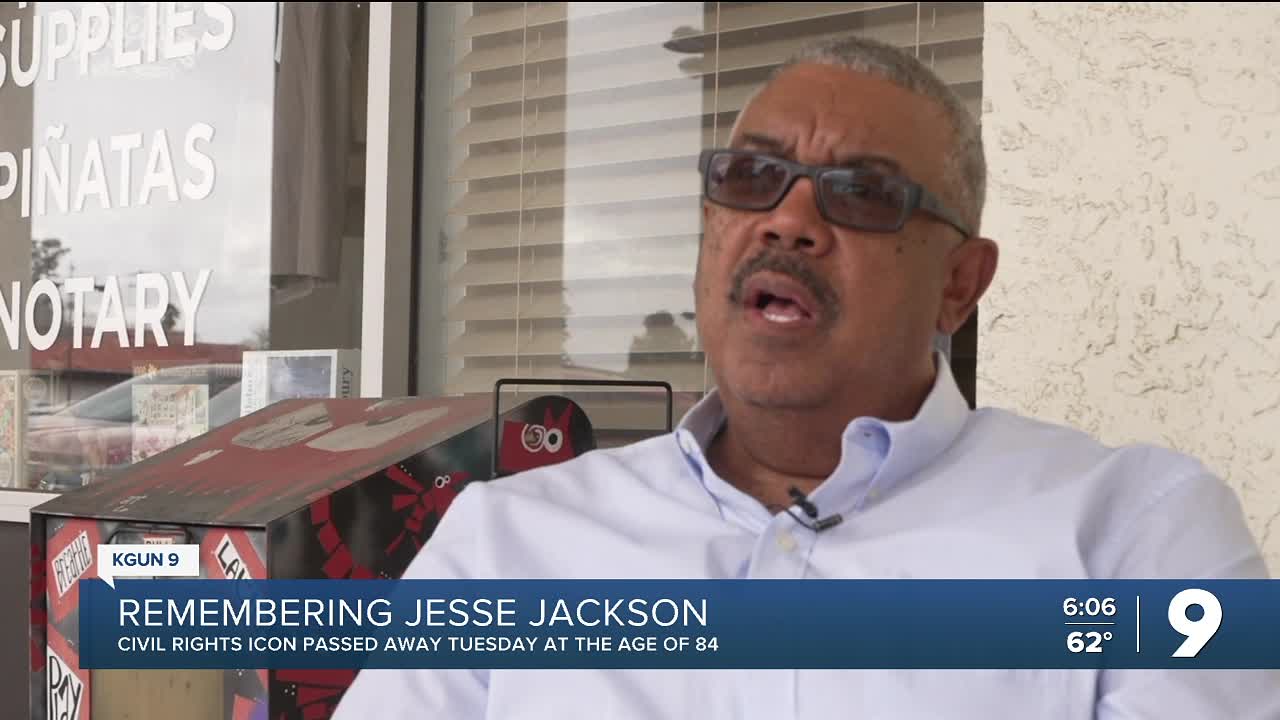


TUCSON, ARIZ. (KGUN) — Communities across the country are remembering civil rights leader Rev. Jesse Jackson and the decades of activism that shaped generations of Americans.
Jackson died Tuesday at his home in Chicago. He was 84.
Here in Tucson, leaders at the Dunbar Pavilion and the African American History Museum of Southern Arizona say his legacy is both historic and deeply personal.
“The entire world has lost a champion, but he is well deserving of his rest,” said Freda Marshall, executive director of the Dunbar Pavilion.
For more than six decades, Jackson was a defining voice in the civil rights movement. He marched alongside Dr. Martin Luther King Jr., founded the Rainbow PUSH Coalition, and launched two presidential campaigns in the 1980s that expanded what many believed was politically possible for Black Americans.
For Bob Elliott, founder of the African American History Museum of Southern Arizona, Jackson was more than a national figure, he was someone he knew personally.
Elliott said Jackson was a regular presence at NBA All-Star Weekend events, where the two would reconnect over the years. When Jackson did not appear at this year’s festivities, Elliott said he became concerned.
“I was a little worried because Jesse always shows up to All-Star Weekend,” Elliott said. “Even the last couple years, his grandson would wheel him in in a wheelchair, but he was going to be there.”
Elliott’s connection to Jackson ran even deeper. His cousin, Archbishop James Lake, was part of Dr. King’s inner circle — alongside Jackson.
“You know, there are so many people that have been a part of the civil rights movement,” Elliott said. “Jesse has been there maybe longer than anybody.”
He described Jackson as a figure who represented not just a person, but a philosophy.
“We’ve lost a person who represents a lot of people,” Elliott said. “Lost a person who represented a way of thinking that… why did he call it the Rainbow Coalition? Because there’s a lot of colors in the rainbow.”
National civil rights leaders also reacted to Jackson’s passing. Rev. Al Sharpton called it a difficult moment.
“It has been a very sad day for me, even though we knew he was very ill,” Sharpton said. “When the moment comes, you’re not prepared for it.”
Elliott said it’s difficult to narrow Jackson’s legacy to any one accomplishment. But one image stands out — Jackson in tears on election night in 2008 as Barack Obama became the first Black president of the United States.
“I think those are tears of not only joy, but he actually had a chance to be alive when we as Americans have a Black president,” Elliott said.
For leaders at the Dunbar Pavilion, once a segregated school in Tucson, now a cultural and community center, Jackson’s life reflects their own history of resilience.
Marshall said his message to young Black children was clear: “Be proud of who you are. Be proud of your skin and you are deserving to be in places that were not designed or made for us.”
She said Jackson helped move the civil rights movement “from protest to policy,” pushing for economic access in addition to social equality.
“He encouraged and really gave a voice to us in the boardrooms,” Marshall said. “Civil rights was not complete without economic access.”
Marshall added that his legacy continues in Southern Arizona, where Black leaders and institutions are carrying the work forward.
“We stand on the shoulders of people like him,” she said. “Now that he’s passed, he’s passed the torch and we have to carry it forward.”
Both Elliott and Marshall said Jackson’s decades-long fight, from the segregated South to national political influence, serves as a reminder that progress requires persistence.
And here in Tucson, they say that responsibility now rests with the next generation.

