

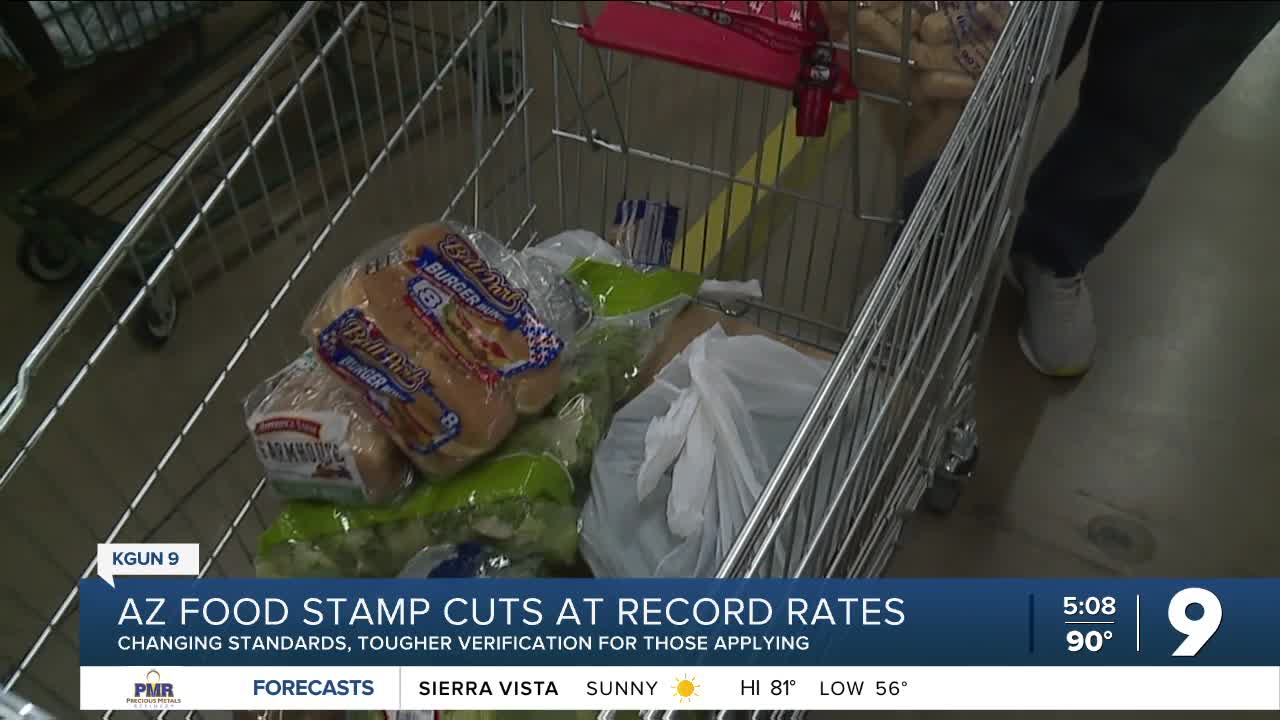


TUCSON, Ariz. (KGUN) — Food costs are going up for everyone. Now a lot of low income people are having a tough time getting and keeping food stamps. Since Congress passed a big budget bill last summer, people in Arizona have been dropping off food assistance at record rates.
Food banks tend to reflect a lot of what’s going on in society and a lot of the people who depend on the Community Food Bank of Southern Arizona for their food are running into higher costs in general and a much tougher time holding on to government food benefits.
“I used to get 110 (dollars). Now I’m down to 94 and my husband used to get 136 which didn't take us anywhere anyway, basically. And then he went got a part time job, so they cut him off completely.”
Lisa Paul gets a lot of help from the Food Bank, but also depends on SNAP to help buy food at regular stores.
SNAP is what used to be called food stamps.
Since Congress passed what the administration calls the Big Beautiful Bill, states have been under pressure to cut people on SNAP.
The Center on Budget and Policy Priorities says Arizona’s SNAP users have dropped by 47 percent—more than any other state.
Part of the drop is because it’s become a lot tougher for people to prove they are qualified.
At the Food Bank, Sio Castillo sees people picking up what the Food Bank can offer while they struggle to get government benefits back.
“What we're definitely seeing is people who were on their benefits, and they've lost their benefits, and now that the state is saying, Yes, you do qualify, but they're not putting them on the roll, so they're 30 days out before they even get food stamps, they get any of their other benefits.”
The Arizona Department of Environmental Services administers SNAP. It says the Federal budget bill imposes more changes than DES has seen in decades.
They include changes to benefits for able bodied adults who have no dependents and much tougher verification to reduce the payment error rate or PER. That’s the measurement of people who were paid too much or too little.
If the error rate is six percent to roughly 8 percent the state has to pay a hundred million dollars.
If it’s eight percent to just under ten the charge is $200 million.
If the error rate blows through ten percent, the state has to pay $300 million.
DES says it’s working to reduce wait times by increasing staff overtime, beefing up appeals teams and expanding what vendors can do.
But those numbers are really about people. And one of them is Lisa Paul.
She says, “It's like a repetitive circle. You keep going in a circle and getting nowhere.”

