

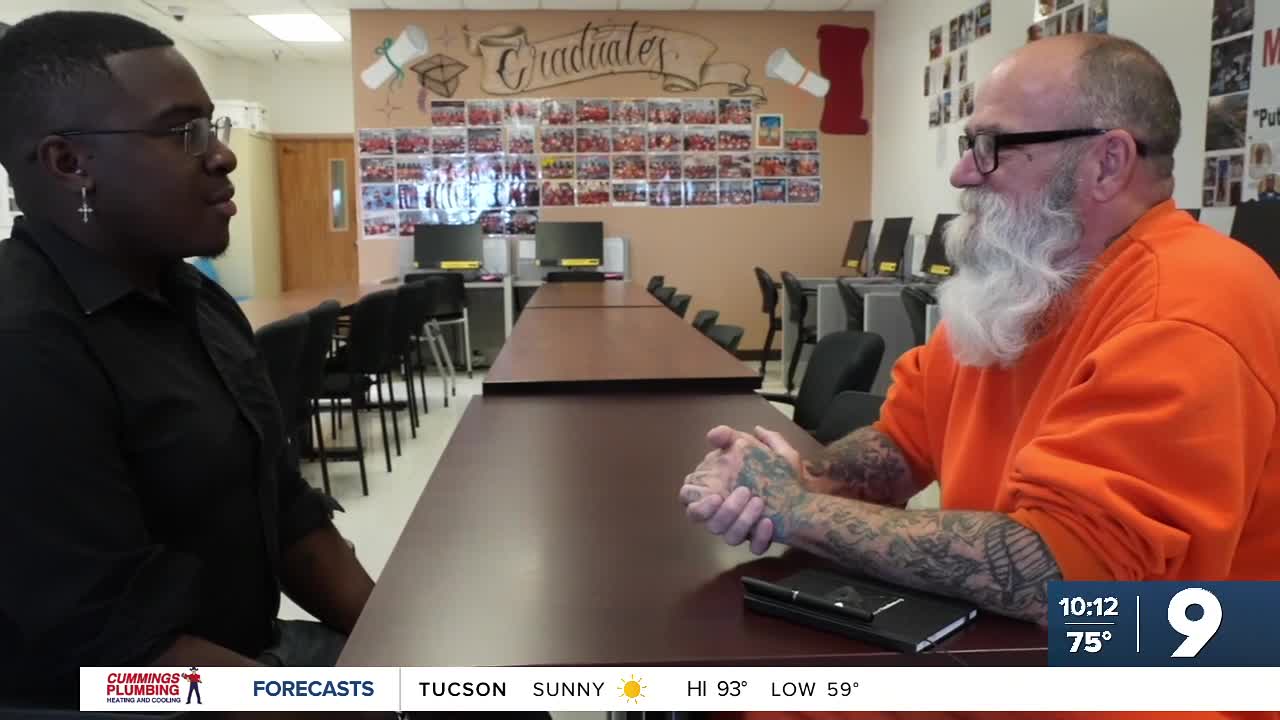


TUCSON, Ariz. (KGUN) — Rico Chavez remembers the number that replaced his name.
"289535. I wish I didn't remember it, but it's something that I'm going to remember forever," Chavez said.
It's the number he lived with for years as an inmate, cycling in and out of prison. Now, he's part of the Arizona Department of Corrections' Second Chance Center program — and working to make sure that number never defines him again.
However, staying out of prison hasn't been easy.
"I always let something like a relationship or family issue lead me back into some type of addicted behavior or whatever that may be," Chavez said.
Prison kept him from his family. He missed his mother's death and time with his son.
"It wasn't easy being in here knowing my mom was gone...and that my son was out there by himself," Chavez said.
J.R. DeHaven's path looked similar; he had been in and out of prison for decades, and fell into the wrong crowd, and away from his wife.
"And I just kind of started going down bad roads..." DeHaven said.
Until he decided to change course.
"I didn't want to lead down the same path that I went down before because, you know, I've been a member of gangs and stuff like that. I just didn't want to go down that path anymore," DeHaven said.
Both men are now part of the Second Chance program...
The Arizona Department of Corrections' Second Chance Center program connects inmates within 90 days of their sentences ending, but are high-risk to reoffend, with job training, education, and support resources.
However, Arizona Corrections Deputy Chief Kennedy Riley says that it provides more than just employment; the program teaches people skills they need to repair their lives.
"It's also interpersonal relationships, housing resources, substance use treatment resources, a variety of things to really focus on the person as a whole," Kennedy Riley said.
The program is producing measurable results. While the state typically sees about 30% of inmates re-offend, that number drops to 10% for Second Chance graduates.
"It's kind of cool, you know, just the way that everybody's here to help you, you know?" DeHaven said.
For Chavez, the difference comes down to something simple... being seen as a person.
"They call you by your name... they don't ask you your number," "It actually makes you want to try harder and give it your best."
When both men get out, Chavez hopes to start an apprenticeship. DeHaven is aiming for HVAC repair. But first, both men are focused on restarting their lives with the people they love.
"But man, my son, bro… I really want to see him and reunite that relationship with him and family," Chavez said.
"I'm going to kiss and hug my wife when she comes to pick me up," DeHaven said.
—
JJ McKinney joined KGUN 9 in July of 2025 as a multimedia journalist. He graduated from Colorado State University in May of 2025 with a degree in journalism and media communications and a minor in law. With a background in investigative reporting and documentary filmmaking, JJ is dedicated to giving a platform to the voices of his community. Share your story ideas and important issues with JJ by emailing jj.mckinney@kgun9.com or by connecting on Instagram, Twitter, or Facebook.


