

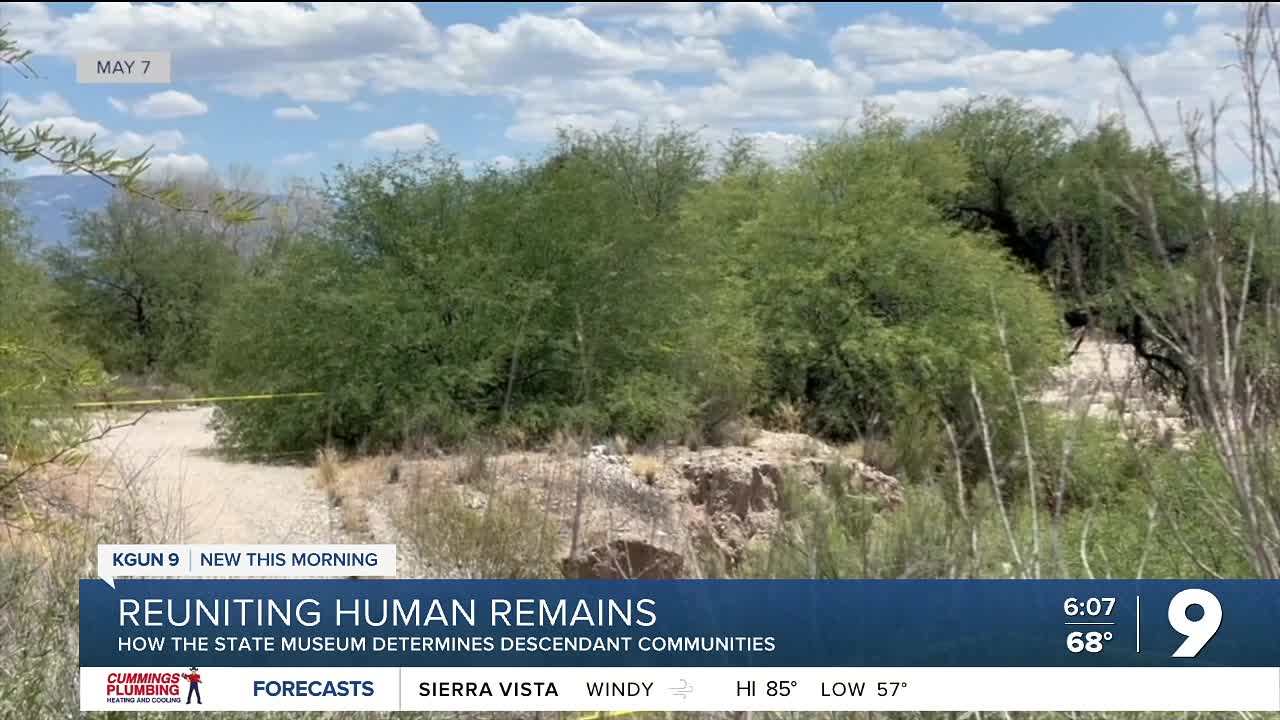


CATALINA FOOTHILLS, Ariz. (KGUN) — When human remains were found near the Catalina Foothills in early May, social media users started speculating about closed cases in the area, assuming a crime.
However, Tucson Police and the Pima County Medical Examiner’s office were able to determine that the area wasn’t a crime scene, and the remains were of archeological origin.
They called in Dr. James Watson, the bioarcheology curator at the Arizona State Museum at the University of Arizona. In his 18-year career at the museum, he’s often responded to found remains. On average, he says, about 12 times a year.
“When archeological remains are found, and we estimate that they’re of a Native American ancestry, we contact the tribes,” Watson said.
Most of those calls went through the process privately, but this one was different. Due to the site’s proximity of about seven miles from Nancy Guthrie’s home, where she was last seen at the start of February.
Because of that, Watson said he needed to move quickly to protect the site and the items found there.
“Cultural sensitivities are important to manage in these cases, and the discovery, disturbance, desecration of ancestral Native American remains has a long history in the United States,” he said.
The area was known to the State Museum as an archeological site. The next steps in identification were focused on surrounding artifacts.
“Where it was located within the riverbank, for example, that it was buried relatively deep versus close to the surface,” Watson. There were some objects in the area—artifacts, ceramic sherds—that were clearly associated with the Hohokam archeological culture.”
Claimant maps from the Arizona Government to Government Consultation Toolkit showed the site could belong to either the Tohono O’odtham Nation or the Pascua Yaqui Tribe. Both were contacted to see if they wanted to claim the remains.
After repatriation, the site is returned to its natural state, erasing all evidence of a dig or excavation to protect anything else that may be left behind.
“There’s the potential for not just remains in the area but cultural resources,” Watson said. “We don’t want people going around and digging through archeological sites. That’s actually a violation of state law.”
In accordance with state law, if you find human remains, Watson says to call authorities. From there, they’ll work with the county medical examiner’s office to determine if the remains are part of a crime scene or are archaeological.
Under the Arizona Antiquities Act, human remains and burial artifacts must be reported to the State Museum—whether found on state or public land.
——
Alex Dowd is a multimedia journalist at KGUN 9, where her work combines her two favorite hobbies: talking to new people and learning about the community around her. Her goal is to eventually meet every single person in Tucson. Share your story ideas with Alex via email, alex.dowd@kgun9.com, or connecting on Instagram or X.


