

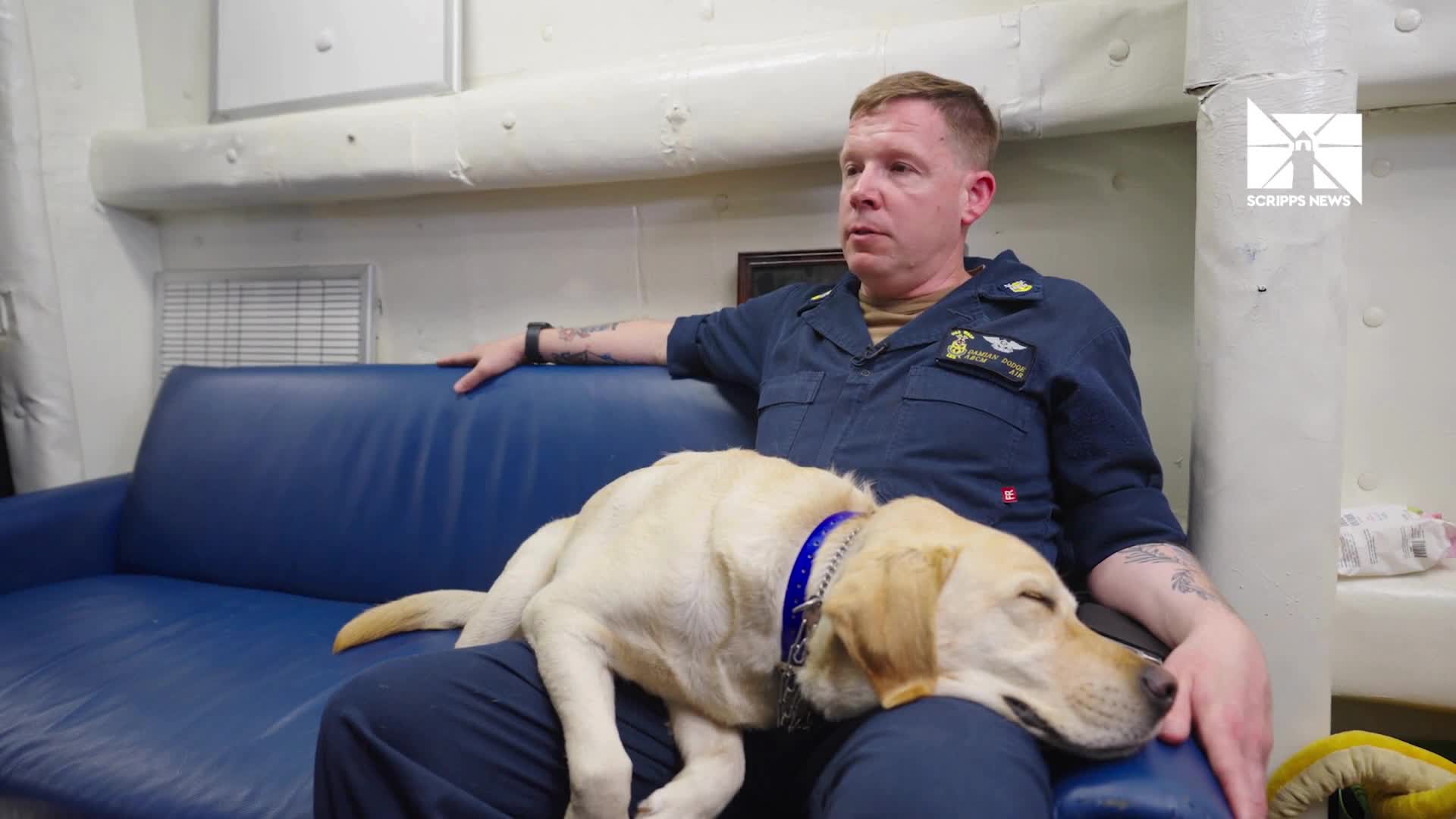


Being on deployment with the U.S. Navy can mean months at sea, and limited options for dealing with stress. But on a handful of ships there’s a special option on board, and it comes in the form of a four-legged crew member.
Commander Ike is a 5-year-old yellow lab and an expeditionary facility dog assigned to the USS Wasp. His duty is to help sailors execute their mission, and sometimes that simply means giving sailors a taste of home.
“He's here for morale, emotional support, things that nature. He's there to kind of like, lift the sailors’ spirits,” explained Master Chief Damian Dodge, Ike’s primary handler and an Aviation Boatswain Mate in the U.S. Navy.
FROM THE ARCHIVES | This is how touch can benefit your physical and mental health
Being at sea for months at a time comes with a unique set of mental health challenges. In the most recent DOD health survey, Naval personnel reported higher rates of serious psychological distress than other military branches. Having a dog on board helps reduce that distress.
“His ability to impact a sailor is immense. Because if you have one sailor that encounters Ike, and let's say they're having, you know, a rough day, and they encounter Ike. And Ike has that ability to refocus that sailor, bring that sailor’s mental state back around to a positive state, to get them to refocus on their mission. He's done his job,” said Dodge.
Ike is one of six Expeditionary Facility Dogs on U.S. Navy ships. The four-legged crew members are on loan from Mutts with a Mission, a Virginia-based nonprofit that trains service dogs and facility dogs.
Brooke Carson is the executive director of Mutts with a Mission, and they’ve been bringing puppies and service dogs to U.S. Navy ships for short visits for years. “We're definitely blessed, because we're here in Hampton Roads, our puppies get to go on ship visits. So they're on ships from the time they're eight weeks old until they graduate,” she explained.
All MWAM puppies go through the same training program, and once they reach 18 months old, Carson and her team assess each dog’s personality to determine whether they’re best suited to be an individual’s service dog, a facility dog at a hospital or police department, or an expeditionary facility dog like Ike.
“As we're looking at our facility dogs, we go, okay, which dog will thrive in a ship environment. Some dogs - you've seen, you saw Ike, that dog was born to be on a ship,” said Carson.
The EFD program was created after one Navy Admiral said he wanted a dog on his ship full time. Each individual ship’s leadership decides if they want an Expeditionary Facility Dog on board, and research shows interacting with an EFD can boost a sailor’s mood for hours.
“Generally, what we've seen is, once a dog is on a ship, the incoming triads, the CO the XO and the CMC, they want to keep that because the program is successful,” said Carson.
RELATED STORY | Quality time with dogs can relieve stress, heighten concentration
In 2023, Captain Sage, a yellow lab assigned to the U.S.S. Gerald Ford became the first EFD to go on full deployment with a ship. The other EFD’s include Captain Fathom on the U.S.S. Abraham Lincoln, Captain Demo on the U.S.S. Eisenhower, Captain Rudder on the U.S.S. Carl Vinson, and Captain Poseidon on the U.S.S. Nimitz.
The dogs’ rank is determined in coordination with the U.S. Navy and MWAM, but the dog’s must out-rank their primary handler. As Master Chief Dodge explained, that ensures the handler has respect for the dog.
Dodge is due to retire from the Navy later this year, after nearly 30 years of service, and he never expected ‘dog handler’ to be part of his Navy career. “Of all the jobs that I've done in the Navy, it's probably like top three for me, the things that I've done in the Navy. And I say that with no reservations whatsoever,” said Dodge.
