

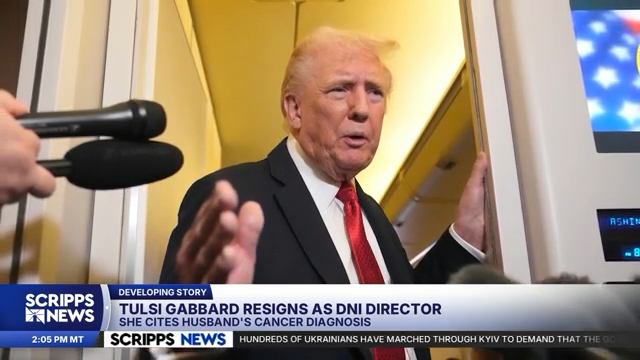


Director of National Intelligence Tulsi Gabbard faced a “tough time” during her tenure in the Trump administration, said Jamil N. Jaffer, founder and executive director of the National Security Institute.
Gabbard will leave the Trump administration June 30, saying she will be supporting her husband, who has been diagnosed with an aggressive form of brain cancer.
Jaffer said that over time, it became clear Gabbard was not part of President Donald Trump’s inner circle. He noted several actions showing she was not aligned with Trump on foreign adversaries.
“She came into it with limited experience,” Jaffer said. “She had some military experience, of course, but limited experience in the intelligence field. Her reputation preceded her in terms of her relationship with staff and her views on information from Russia and the like. But even when she got to the Trump administration, she faced challenges.”
RELATED STORY | Director of National Intelligence Tulsi Gabbard to resign next month
Among her actions, Gabbard posted a video last year critical of nuclear weapons, glossing over the fact that the United States is among a handful of nations with a large nuclear arsenal.
"This isn't some made-up science fiction story. This is the reality of what's at stake, what we are facing now, because as we stand here today, closer to the brink of nuclear annihilation than ever before, political elites and warmongers are carelessly fomenting fear and tensions between nuclear powers," Gabbard said in the video.
Jaffer also noted that Gabbard’s appearances at White House events were infrequent. She was not a visible presence during U.S. military actions in Venezuela and Iran this year.
“She didn't defend it, but she didn't come out against it either,” Jaffer said of Gabbard’s stance on the war in Iran. “That’s obviously a real problem for the White House, which was very forward leaning on that conflict. She didn’t support the Venezuela operation. She didn’t support the Iran operation. The president has been much more interventionist than his base thought he would be, and that reflects on her as well. President Trump does not like having people around him who do not support where he’s going.”
Trump posted his support of Gabbard on Truth Social.
"Tulsi has done an incredible job, and we will miss her," he said.
Gabbard drew scrutiny from Democrats after stating in 2025 that she did not believe Iran was working on building nuclear weapons. Trump has cited his desire to prevent Iran from developing nuclear weapons as his justification for launching an attack on the nation.
Gabbard was confirmed weeks after Trump began his second term in 2025. She previously served as a Democratic member of Congress and was a presidential candidate before joining the Republican Party and endorsing Trump. Her confirmation did not receive bipartisan support, and former Republican leader Mitch McConnell voted against it.
Gabbard said she is committed to a “smooth transition.” Trump announced that Principal Deputy Director of National Intelligence Aaron Lukas will serve as acting director.
Jaffer said there will be concerns about having a director leading national intelligence who is not Senate-confirmed.
RELATED STORY | Gabbard grilled on Iran war, Fulton County presence at Senate hearing
“We are in a heightened state of threat today in this country, not just because of the Iran war, not just because of the Venezuela conflict, not just because of what’s happening with Russia and Ukraine, but because China is constantly looking at us and is in a constant adversarial posture toward us,” he said. “There remain terrorist groups focused on the United States, attacking us here at home and our allies abroad.
“This is a time of great moment for our nation. We are at probably the highest threat we’ve been since even before 9/11, given all the nation-state threats and terrorist threats against our country. So not having a director of national intelligence is a challenge.”
