

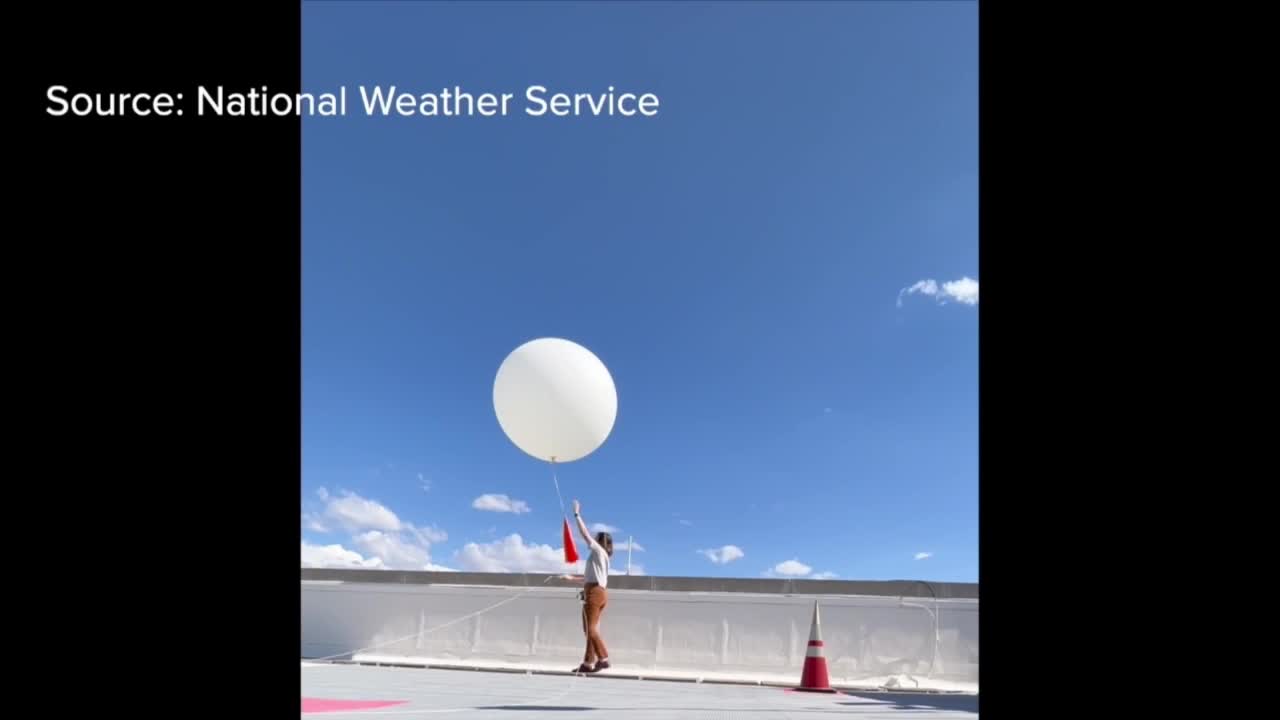


TUCSON, Ariz. (KGUN) — One of the important forecasting tools for Tucson’s National Weather Service has been grounded—at least for now.
Helium balloons are not just a toy.
A different sort of helium balloon is a serious tool that lifts weather instruments high into the atmosphere to give meteorologists information like moisture data that helps them perfect, say, a monsoon forecast.
Marc Singer leads the National Weather Service office for Tucson says, “If we know what the precipitable water is, which is a measure of the water in a column of air, for example. We can use that information to say that today is more of a flash flooding threat as opposed to a wind threat.”
But the National Weather Service Office in Tucson hasn’t been launching weather balloons since late January.
Helium is plentiful in space but hard to find on Earth. The nature of its chemistry means you can’t really create it from other materials.
The Middle East is one place to find it but the Iran War has slowed or stopped the ships that carry helium. Helium handling facilities have been attacked and damaged too.
But Marc Singer says that’s not what affected his helium supply. He says it’s a packaging problem.
His helium had been delivered in large tanks. They can weigh 130 to 140 pounds apiece. They’re so hard to handle safely the supplier shifted to smaller tanks.
It’s taken awhile to create new storage for the new tanks, and change the plumbing to pipe the helium up to the launch site on the roof.
Marc Singer says his office can create accurate forecasts using other data including balloon data from the weather service in Phoenix.
“So we do have model soundings that come from numerical weather prediction models that we can use to simulate what's happening that are very similar to actual observations. It's not going to be a perfect one-for-one match of what we would get from an observational balloon launch, but it does get us to the point where we can see what's going on in the atmosphere.”
But he says the new helium system will be ready soon. Once it is, he says he’ll be back to launching balloons twice a day for the extra information they add to the forecast.

