

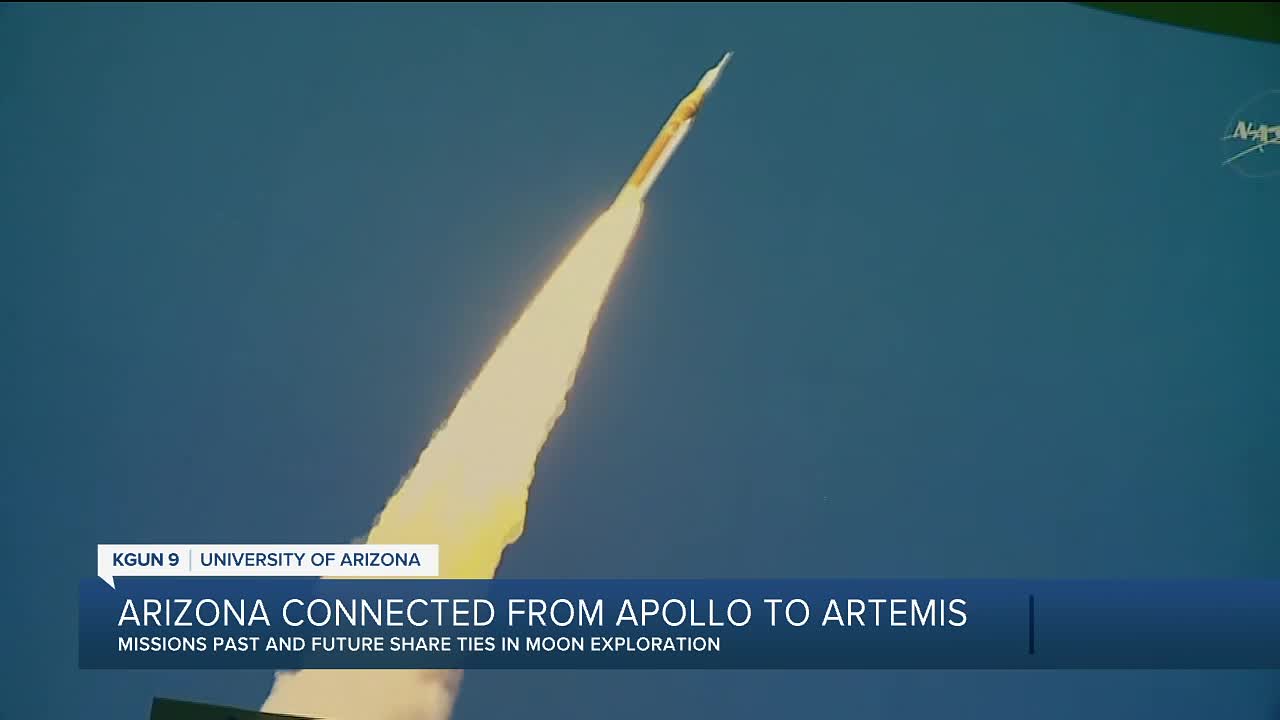

TUCSON, Ariz. (KGUN) — About 75 space fans gathered at U of A’s Flandrau Science Center to watch the Artemis launch.
Flandrau projected NASA’s video feed in the Center’s planetarium.
The audience applauded at launch milestones like liftoff and confirmation that the crew had safely reached orbit.
Some parents made a point of bringing their children to see the launch.
Carson Paquin says, “It was crazy the amount of all the smoke stuff that came out of the rocket when it blasted off. That was a whole bunch of it.”
Adrian Vasquez said of the launch, “I think it's really cool because people can explore. Because maybe people that are kids, right? Maybe they want to go to the moon one day; and maybe when they grow up, they can go to the moon.”
U of A and Tucson have a long history of moon exploration.
University scientists produced detailed maps of the moon, which NASA used to plan landing sites; and they helped train astronauts how to take scientific readings as they walked on the surface.
Before we landed anything on the moon, there were concerns that the moon was a ball of dust so deep that it could swallow anyone who landed there.
U of A played an important role in the early robot probes that crash landed on the moon to help confirm it had a solid surface.
U of A will be important in the future of moon exploration, too.
Professor Veronica Bray Durfey is working on an instrument set to go to the moon on a future Artemis mission. By measuring moonquakes, it should help us learn more about what’s beneath the Moon's surface.
She says, “It's really tricky to adapt a seismometer to work on the moon. It has extreme temperature swings that your equipment needs to be ready for, like, minus 160 centigrade, you know, plus more than 50 centigrade is what we've checked out our seismometers for.”
U of A continues to be a world leader in space exploration, with important contributions to the study of the Moon, Mars, other planets, and asteroids.
——-
Craig Smith is a reporter for KGUN 9. With more than 40 years of reporting in cities like Tampa, Houston and Austin, Craig has covered more than 40 Space Shuttle launches and covered historic hurricanes like Katrina, Ivan, Andrew and Hugo. Share your story ideas and important issues with Craig by emailing craig.smith@kgun9.com or by connecting on Facebook and Twitter.


