

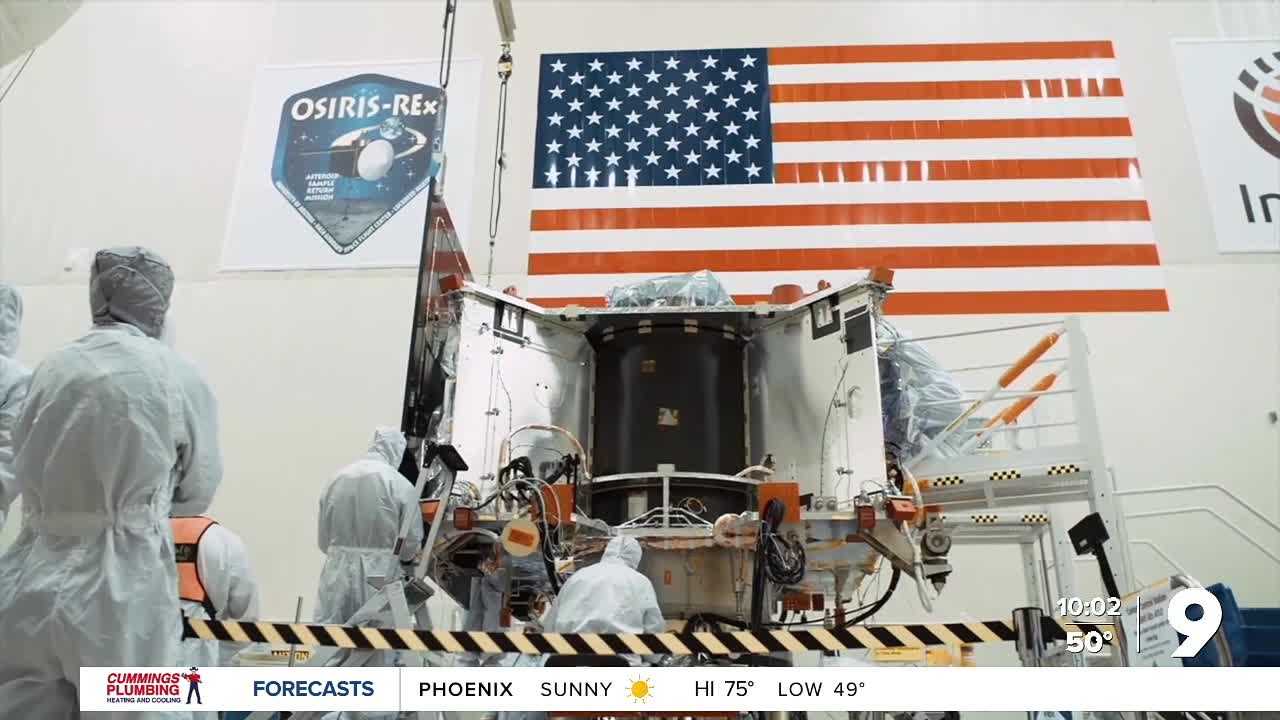


Representatives from Pima County and Baja California, Mexico, met to discuss expanding aerospace, defense, and semiconductor industries across both regions, focusing on supply chain growth, job creation, and manufacturing opportunities.
Heath Vescovi-Chiordi, Pima County's economic development director, led discussions with about 20 state government, industry and academic leaders from Baja California about creating stronger cross-border business connections.
"We're going to make that connection across the borders," Vescovi-Chiordi said.
The initiative aims to help companies on both sides of the border collaborate and strengthen their operations without requiring physical relocation.
"Companies that exist here can kind of tap into companies that exist there and vice versa," Vescovi-Chiordi said. "If they don't physically locate here in Pima County they can actually work with companies across the border and effectively strengthen their supply chain and their manufacturing chain."
The Chamber of Southern Arizona, which was also involved with the talks, reported that Pima County hosts over 200 local and large international aerospace companies, providing a strong foundation for expansion efforts.
Vescovi-Chiordi emphasized that growing jobs involves using existing aerospace assets in the region.
"You basically just create a compendium of all of those opportunities because of the assets that you have within the region," Vescovi-Chiordi said.
The University of Arizona played a key role in the discussions, exploring how educational institutions can better prepare students for careers in these growing industries.
Justin Dutram, the University of Arizona’s assistant vice president for western hemispheric affairs for Arizona International, highlighted the need for more workers in these sectors.
"We need more graduates, we need more folks who are trained and able to work in those sectors," Dutram said.
The university's approach involves developing workforce training programs that serve industry needs across both regions.
"To develop a workforce that's complimentary and that has some overlapping characteristics that can serve the industry," Dutram said.
Krishna Muralidharan, the director of the University of Arizona's Center for Semiconductor Manufacturing and an engineering professor, explained that the university is emphasizing skills training for students from both Mexico and Arizona.
"To be part of curated curriculum pathways so that as they go through this they know where they're going to find a job," Muralidharan said.
Vescovi-Chiordi stressed that these cross-border meetings prioritize actionable results.
"It's based on getting things done. We're not just meeting to meet so we're going to have some type of tangible outcome here and I think that's very valuable for everybody," Vescovi-Chiordi said.
In the next five our ten years Vescovi-Chirodi said both regions will have grown, which he said is going to help other industries like healthcare and communications.
“What we’ll see is the ability for us to kind of connect smaller and medium-size businesses so that they’ll be able to grow,” he said.
In the near future, Vescovi-Chiordi said Pima County plans to meet with leaders from Mexicali to continue building these cross-border partnerships.
This story was reported on-air by a journalist and has been converted to this platform with the assistance of AI. Our editorial team verifies all reporting on all platforms for fairness and accuracy.
——-
Andrew Christiansen is a reporter for KGUN 9. Before joining the team, Andrew reported in Corpus Christi, Texas for KRIS6 News, Action 10 News and guest reported in Spanish for Telemundo Corpus Christi. Share your story ideas with Andrew by emailing andrew.christiansen@kgun9.com or by connecting on Facebook, or Twitter.


