

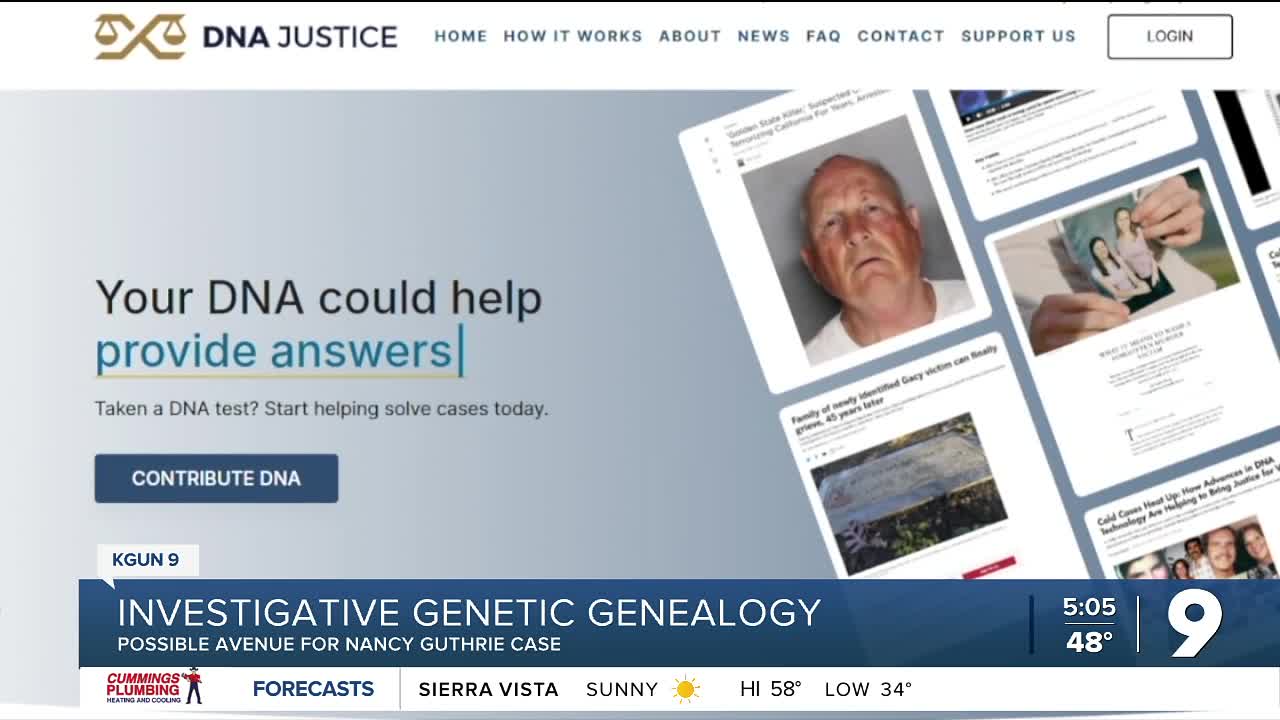


Because the DNA found on a glove a couple miles from Nancy Guthrie's home didn't come up as a match in the national law enforcement database, CODIS, the evidence may feel like a dead end. But one possible avenue the investigation could take from here, could be investigative genetic genealogy.
The Pima County Medical Examiner has used the technique to solve cold cases, often working with the company Moxxy Forensic Investigations. They get DNA into different genealogy databases, and build a profile through research.
While Moxxy is not involved Nancy Guthrie's case right now, KGUN 9's Claire Graham spoke with an investigative genetic genealogist at Moxxy, Ed Adams, who says there are still possibilities. Here's part of their conversation below.
Claire: "What do you think the likelihood is that this profile of DNA (found on the glove) will pop up with distant relatives if it is put into these databases?"
Ed Adams: "So if they use investigative genetic genealogy, in this case, they will find cousins. That's guaranteed. They'll find lots of cousins. I mean, it's not unusual for us to get 10,000 plus records that are related to an unknown individual, and then we can do just traditional documentary genealogy, where you're looking up census documents, marriage certificates, probate records, to try to identify how these relationships all connect to each other, because each of those genetic cousins that you've gotten from those databases will be related to your unknown individual. But many of them are also related to each other, and that is really the crux behind how we figure out who the unknown individual is."
Claire: "How successful is investigative genetic genealogy?"
Ed Adams: "Very successful. So almost probably weekly, cases are being closed using investigative genetic genealogy, and it's precisely because we're all related. You know, the human species is one big family in such a way that it's, I would say, very rare to almost unheard of, that you could not identify someone using this technique."
Claire: "So if anybody watching this wants to help, what's something that any of us could do?"
Ed Adams: "So the average person is fully capable of being a witness in any case like this, and we call it a genetic witness. If you have taken a commercial DNA test through Ancestry.com, My Heritage, Family Tree DNA, 23andme, there's a bunch of them, You can download your genetic profile from that website, which we do not have access to. We cannot access any of those commercial DNA testers information, but that information is yours, the testers. So you can download that information and upload it to GEDmatch, to Family Tree DNA, or to DNA justice and opt in -- you have to click a little box to opt in to allow law enforcement to search your genetic profile, and you can become a genetic witness. And I would say that the technique is so useful that if you do upload your information and you opt in, you will help solve a case."
Claire Graham is an anchor and reporter for Good Morning Tucson on KGUN 9. She grew up in Tucson and graduated from the University of Arizona with a degree in musical theatre. Claire spent a decade in Washington state, but she's thrilled to be back home in the beautiful southwest with her husband, two young sons and two rescued dogs. Share your story ideas and important issues with Claire by emailing claire.graham@kgun9.com or by connecting on Facebook and X.


