

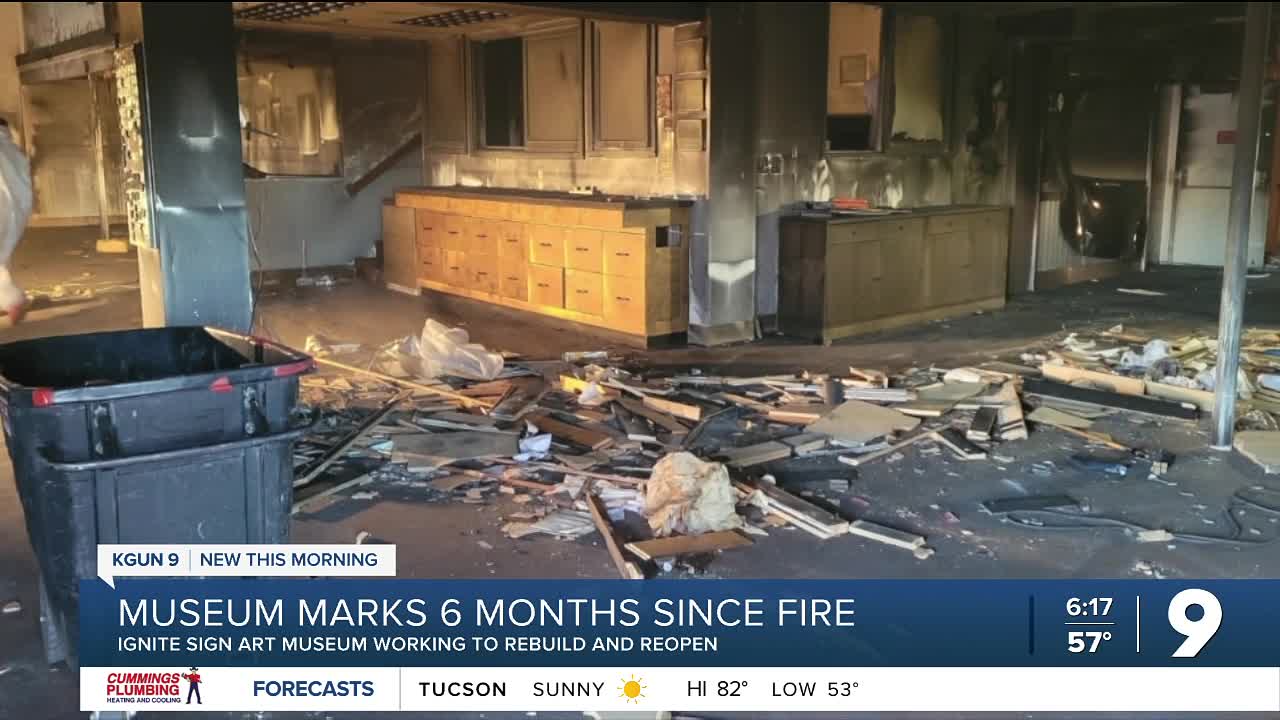


TUCSON, Ariz. — Saturday, April 18th marks six months since a devastating fire ripped through the Ignite Sign Art Museum in midtown Tucson. The museum told a unique story about Tucson's past for years, but the owner is building back now to someday light up the neon once again.
Walking inside the building, the once familiar sounds of the museum are missing. The undeniable buzz of neon and the constant blinking of lights are gone.
"We really lost about 90% of the small stuff, the stuff that was valuable," explained the owner, Jude Cook. "We have the big stuff, which is what's, you know, the historic stuff. So we're in good shape there, because the fire didn't hurt that part of it."
That "stuff" big and small, was Cook's one of a kind, personal collection. He says a lot of the small items that burned were unique, or the kind of thing he bought for a few bucks years ago and had only ever seen one other places, listed for thousands.
His museum, once filled with the signs, neon lights, and trinkets he collected and sometimes made over the last 50 years, is now an empty, burned out, hollow hall.
He thinks an old radio overheated one night back in October, when no one realized it was still on. It was on a 1930s Queen Anne radio desk, and the fire quickly spread through the rooms of the museum, burning the paint off the floor, moving up the walls, hitting the ceiling and then pluming out to damage the rafters.
"It came around the corner, it took out my beer signs, and then it apparently went this way and really destroyed my clock wall," explained Cook, walking us through the path the fire took. "And then what I had on this wall was miniatures of Tucson signs, that were small versions of signs still out in the community. And it was hot enough to actually melt the neon. The neon bends at about 800 degrees. So the neon actually collapsed on itself."
Cook didn't find out about the fire until the day after it, when a member of the KGUN staff saw a Facebook post by the fire department about the fire, and reached out to Cook, just to send their sympathies. Cook says firefighters tried to call his wife that night, but they somehow didn't connect as the fire was burning. When he raced over to the museum after learning about the fire, he found the severe damage, with the doors still wide open.
As stark as it is to see the empty museum now, it has taken Cook and his team a lot just to get to where they are now. That started with waiting a month just to get the cleanup crews in.
"We just sat here for two weeks with just the muck, you know, the stuff was wet and just soggy, and you had all the insulation and the drop ceilings and the drywall," he said. "They filled eight dumpsters, big dumpsters full of just the debris that we took out, both collection and just construction debris."
They also had to empty out the whole other half of the museum, that didn't fully burn, but was entirely covered in soot. Since then, Cook's days have been filled with calling contractors, getting permits, drawing up new plans, cleaning the soot off everything, and even soda blasting the building. From here, he needs to get new plumbing put in, all new electrical work, new doors, a new roof, and even new walls in some spots.
"I was trying to save cabinets like in the kitchen area, and it's not worth it. Everything smells like smoke," he explained.
You might think moving to a new building might be easier than redoing everything, but Cook says not only was it hard enough to find this building, moving all of the large signs in the yard, would be a massive challenge, so staying put makes more sense. While insurance is covering most of the replacements for the existing building, it won't pay for new work. Unfortunately that includes adding a sprinkler system, that the museum didn't have before.
"You've got around $40,000 for a sprinkler system, but you have to hook up the water. City Water is marked and ready. I've got a check for them. The city waters is $24,000 to hook up. So you got about $64,000 just in getting a sprinkler system in place, but I don't ever want to go through a fire again," Cook said. "It's disheartening to lose stuff that way."
Cook says the big iconic signs from around Tucson that we all recognize from the past, that the fire didn't take, are what will make all of this recovery worth it, to someday reignite.
"We didn't really lose the stuff that gives us clout to be a museum. Had we lost that and still had my small collection, we'd just clean up the building and quit because there wouldn't be enough. But we have enough to get back open," Cook said.
He hopes he'll be done fixing up the building about six months from now, right around the one year anniversary of the fire. From there, he'll start arranging the displays again. It's a tall task, but Cook is staying positive.
"We've been lucky," he said. "We've saved a lot of stuff, and we've collected, we've had stuff donated to us. So we're going to get built back up again. We're going to redesign the entire museum."
One thing that hasn't been charred, is Cook's love for preserving history, and our community that loves it right back. He's been holding "fire sales" and fundraisers at the museum, he's running a GoFundMe page online, he has a mobile gift shop he can roll out, and he has his other neon business that has been hosting workshops and classes.
"We've had such good support from friends and people that have been here," Cook said. "They've been really good about just being positive about it. And I think as bad as the fire was, we got exposed to people that didn't even know we existed. And so, our reach is greater than it used to be. I just want to keep that in place and keep it going."

