

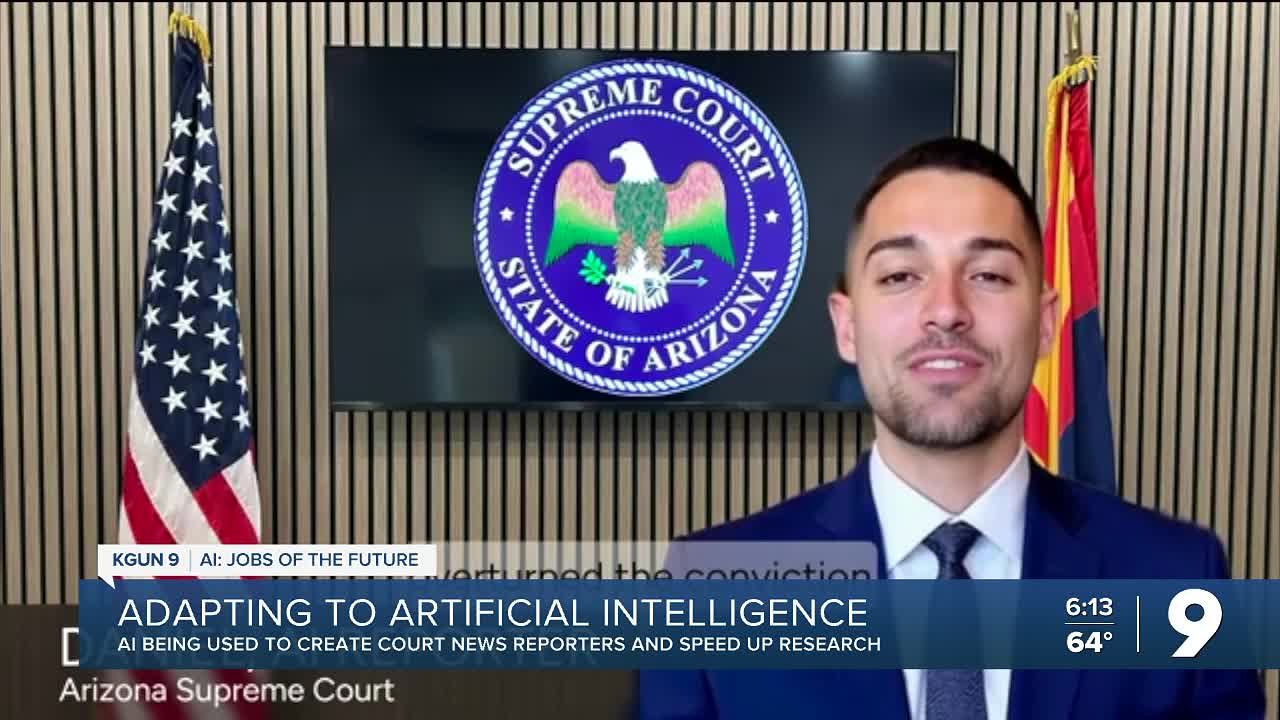


TUCSON, Ariz. (KGUN) — Arizona's Supreme Court has introduced two artificial intelligence court reporters named Daniel and Victoria to help make legal opinions more accessible to the public and journalists.
The AI reporters debuted about a year ago as part of an effort to bridge the communication gap between complex court decisions and public understanding.
Alberto Rodriguez, the Arizona Supreme Court's communications director, worked with the Chief Justice to create the digital personas.
"We just saw that there was maybe a gap in us being able to deliver a concise summary of the opinion," Rodriguez said.
The AI reporters are designed to look like real people, though they are entirely computer-generated.
"We wanted the public to feel like they could identify with them, so we made them racially ambiguous," Rodriguez said.
The Supreme Court's communications team feeds Daniel and Victoria scripts based on actual summaries written by the authoring justice of each opinion. This process helps Rodriguez streamline his work while making legal documents more digestible for the general public.
"So that made my life easier because I'm able to work with them in drafting a script that the public can understand," Rodriguez said.
For journalists covering court cases, the AI reporters offer a significant time-saving advantage. While reviewing court documents and justice opinions can take hours, the AI summaries provide quick, accessible overviews.
"You can report on that at your earliest convenience because we've really encapsulated it for you as a journalist so you can report it to the public," Rodriguez said.
Rodriguez said the AI reporters also help communications experts like him when working with media. When journalists request interviews with lawyers or legal experts about a justice's opinion, those experts typically need to read the entire opinion first. The AI reporters help streamline that process so everyone involved understands what's happening in the case.
The legal field's adoption of AI extends beyond court communications. Jaime Ibrahim, deputy director at Southern Arizona Legal Aid, has been using AI for nearly a year to assist with legal research and document drafting.
"It's really mostly used for time saving and to help point you in the right direction if it's something that you're not familiar with," Ibrahim said.
However, Ibrahim emphasizes the importance of maintaining strict boundaries when using AI in legal work. Client confidentiality and data security remain crucial concerns.
"We do have to be careful to make sure that we never put client names in any AI database. We're also very careful to make sure that we limit how many specific facts that we put in," Ibrahim said.
Despite AI's growing presence in legal work, Ibrahim stresses that it cannot replace professional legal counsel.
"It's fine for simple questions to point you in the right direction but ultimately you really can't use that in place of true legal advice from a licensed attorney," Ibrahim said.
Looking ahead, Rodriguez plans to expand the AI court reporters' capabilities by offering them in different languages. Ibrahim hopes to use AI in the near future to streamline email communications and client intake processes.
"This story was reported on-air by a journalist and has been converted to this platform with the assistance of AI. Our editorial team verifies all reporting on all platforms for fairness and accuracy."
——-
Andrew Christiansen is a reporter for KGUN 9. Before joining the team, Andrew reported in Corpus Christi, Texas for KRIS6 News, Action 10 News and guest reported in Spanish for Telemundo Corpus Christi. Share your story ideas with Andrew by emailing andrew.christiansen@kgun9.com or by connecting on Facebook, or Twitter.


