



TUCSON, Ariz. (KGUN) — The rapid growth of artificial intelligence is changing industries all over the world including our own. But as we work to bring you the news and information you need every day, we're also trying to adapt and innovate to do our jobs better.
I've been in television news for a while. Even at the beginning of my career when I first arrived at KGUN9, we had just moved beyond editing tape-to-tape so it's not as if we haven't tried to harness new technologies in this industry in the past to move forward.
Television news has always been a visual medium, capturing video of the world around you to tell stories in the most clear and concise way possible. It's just a clearer picture post hi-definition. Pioneering reporter Edward R. Murrow said that TV was just lights and wires in a box if human beings didn't use it to "teach, illuminate and inspire" the general public. We've still got plenty of lights and wires, and computers, and access to radar equipment and a whole slew of tools including artificial intelligence.
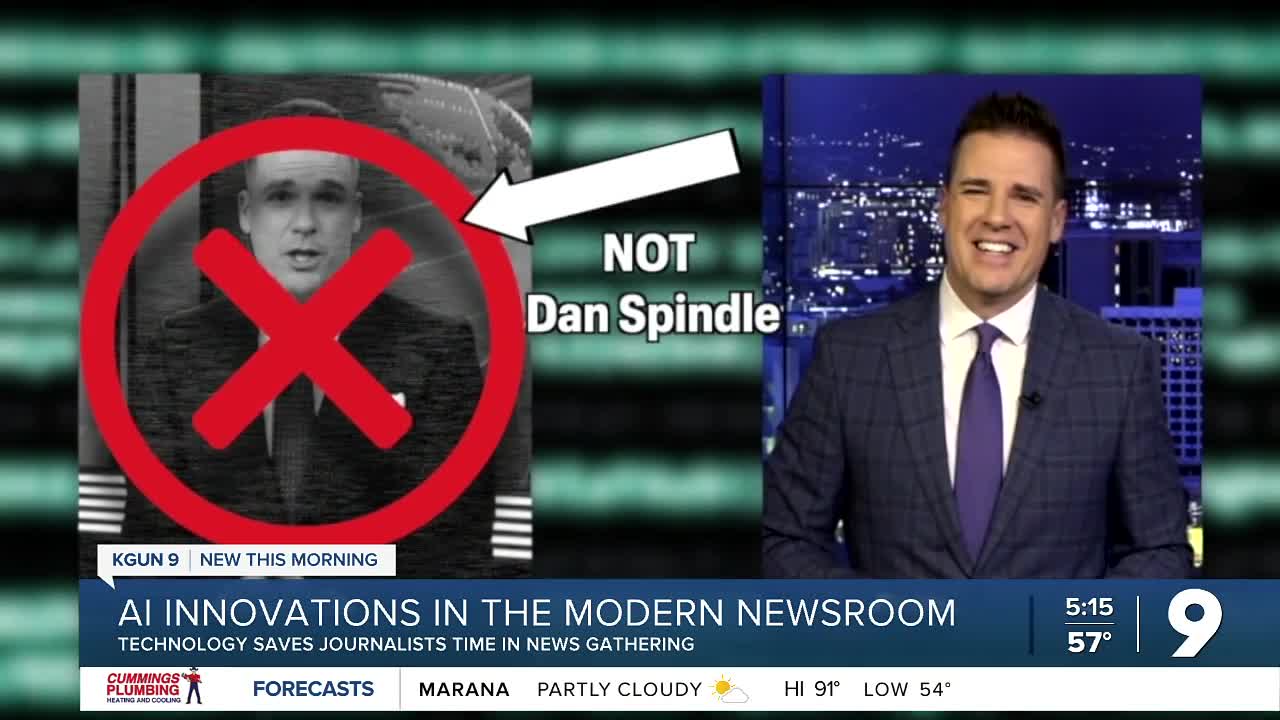
"When we talk about new technology that we use to tell stories like AI - this isn't exactly what I'm talking about. This image and this voice; they're not real"
"That's kind of a hard line for us in news. We don't want to be in the business of creating images that don't exist," said Keith St. Peter.
Generative AI - creating images that aren't real. That's what Keith - our parent company Scripps Director of Newsroom AI is talking about. In fact, we don't really want to replace journalists with our digital counterparts. Take Keith's job, for example. It was created by AI. It didn't exist just a few months ago. But thanks to the need to use and teach how to incorporate this new tech, not fear what the future holds, Keith's career took a new turn.
"The baseline is that we always have a human in the loop," Keith said.
KGUN 9 News reporter Jaqueline Aguilar has worked in news for four years and she's coming up in an industry that's changing fast. She's learning to utilize Scripps' AI tool called Engine Room to take care of some of her day-to-day tasks.
"It's those little things that help cut a lot of time. Especially when you're nearing the end of your day," Jackie said.
She's referring to posting articles on the web and our app from a script that looks pretty messy with commands meant for on-air broadcasting. But check out how long it takes. Instead of a 20 to 30 minute task, I put a script of mine into Engine Room's digital conversion tool and literally within seconds I've got the formatted script, potential titles for YouTube and social media, follow up story ideas, everything.
"Any extra time I can use on my own to make the article pop more but at least I know the basics are done with the digital conversion tool," Jackie told me
You'll notice a disclaimer at the end that states that AI was used as a tool for the web story but there's always a review process with a manager; a living and breathing journalist whose experience is backed by years of gathering the news, talking to real people... not just in ones and zeros.
"It's specifically not meant to replace a conversation with your manager when you need a script review. It's something that's meant to help augment the process entirely. It's essentially like bringing another perspective into the conversation," Keith told me.
Taming the digital wilderness will, no doubt, reveal even more challenges and opportunities over the next horizon which, at the pace that artificial intelligence advances, is already here.
You can watch the KGUN 9 News special presentation "AI Jobs of the Future" here

