

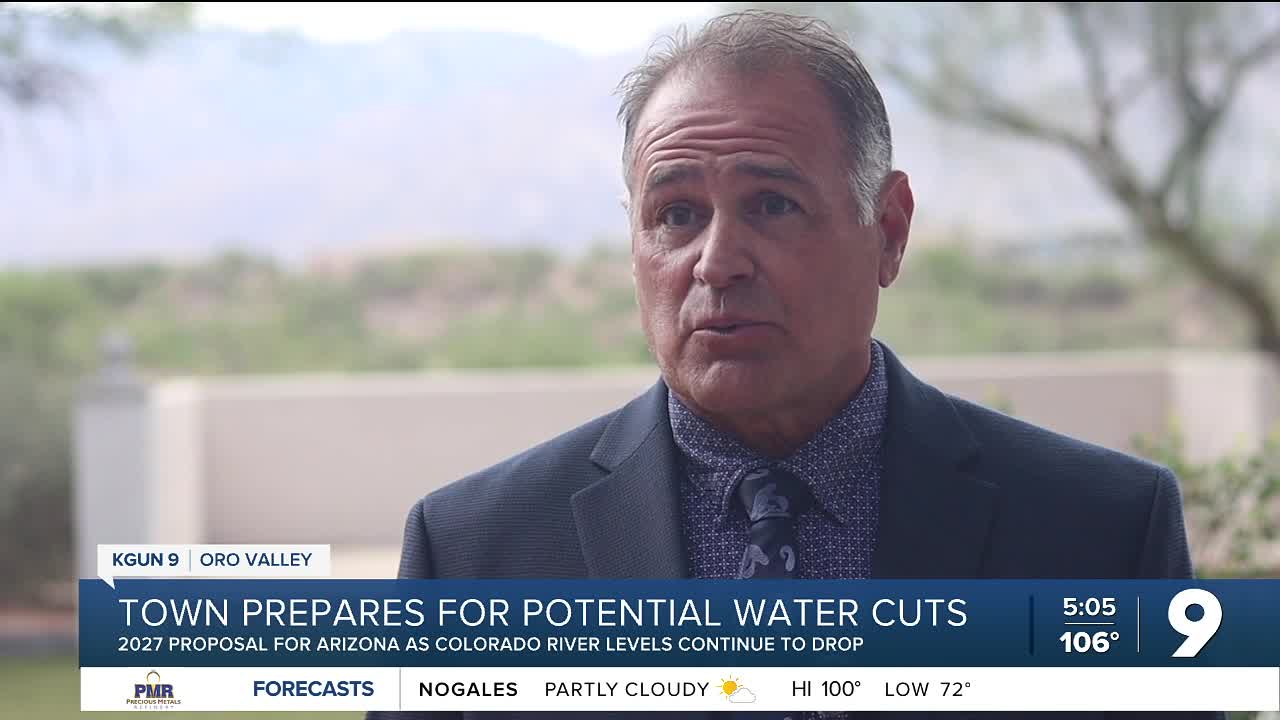


ORO VALLEY, Ariz. (KGUN) — Oro Valley is bracing for a potential cut to its Colorado River water supply, but the official in charge of keeping the town's taps running says residents shouldn't panic.
Water Utility Director Peter Abraham said the town has been informally told to prepare for an approximately 20% reduction in its Central Arizona Project allocation — the canal system that delivers Colorado River water across the state — beginning in January 2027.
"A 20% cut will not be seen from a water resource perspective by our customers," Abraham said.
The warning came out of a recent meeting between the CAP, the Arizona Department of Water Resources and stakeholders like Oro Valley. The figure is not finalized — the federal Bureau of Reclamation still has to sign off — and Abraham noted it could ultimately be more or less than 20%.
Oro Valley draws its water from three sources: groundwater wells, reclaimed water and CAP supplies. Abraham said a 20% reduction would not mean less water coming out of residents' taps. Instead, the town would simply store less water underground for future use.
"We're going to be storing less water, but we'll still be able to deliver the full amount that we have, and we'll still be able to replace the groundwater we pump with the CAP supplies," he said. "We'll just be storing less in 2027."
Decades of planning:
Abraham emphasized that this moment is not a surprise. Oro Valley has spent years banking water underground, accumulating tens of thousands of acre-feet in long-term storage credits — essentially a cushion the town can lean on if shortages deepen.
The town has also worked aggressively to reduce its dependence on groundwater. Since beginning CAP water deliveries in 2012 and reclaimed water deliveries for turf irrigation in 2005, Oro Valley has cut its groundwater pumping by more than half. As a result, between a third and half of the town's 18 production wells have shown signs of aquifer recovery.
"Groundwater really is this community's ultimate safety net," Abraham said. "It's beneath our feet, it's abundant, it's of the highest quality, and that's why we've been working so hard to preserve and protect those supplies."
Abraham described an extensive network of backup strategies — called firming — that the town can draw on if CAP cuts go deeper than expected. Those include the Arizona Water Bank, which holds over 600,000 acre-feet of stored water in southern Arizona, and the Central Arizona Groundwater Replenishment District.
"We have all these firming strategies to buy us decades and decades of time if the shortage cuts really, really deep," he said.
Where residents will feel it:
Abraham was careful not to sugarcoat everything. While Oro Valley's water supply is secure, he said residents will notice a difference in their bills.
"When they turn on the tap, the water will be there," he said. "But what I would expect, where they will notice a difference, is every year I expect water resource costs to go up three to five percent every year just because there's less of it."
Abraham attributed the expected increases to basic supply and demand. As the Colorado River shrinks, competition for what remains drives up the cost of water as a commodity. He noted that 84% of Oro Valley customers currently fall into the lowest consumption tier — using between zero and 7,000 gallons per month — and that the town uses tiered pricing to encourage conservation.
Despite the challenges ahead, Abraham struck a measured tone.
"We are in a state of crisis," he said. "We need to act now so we're not in a state of emergency in the future. But as far as our residents — now and for decades to come — when they turn on the tap, the water will be there."
----
STAY IN TOUCH WITH US ANYTIME, ANYWHERE


