

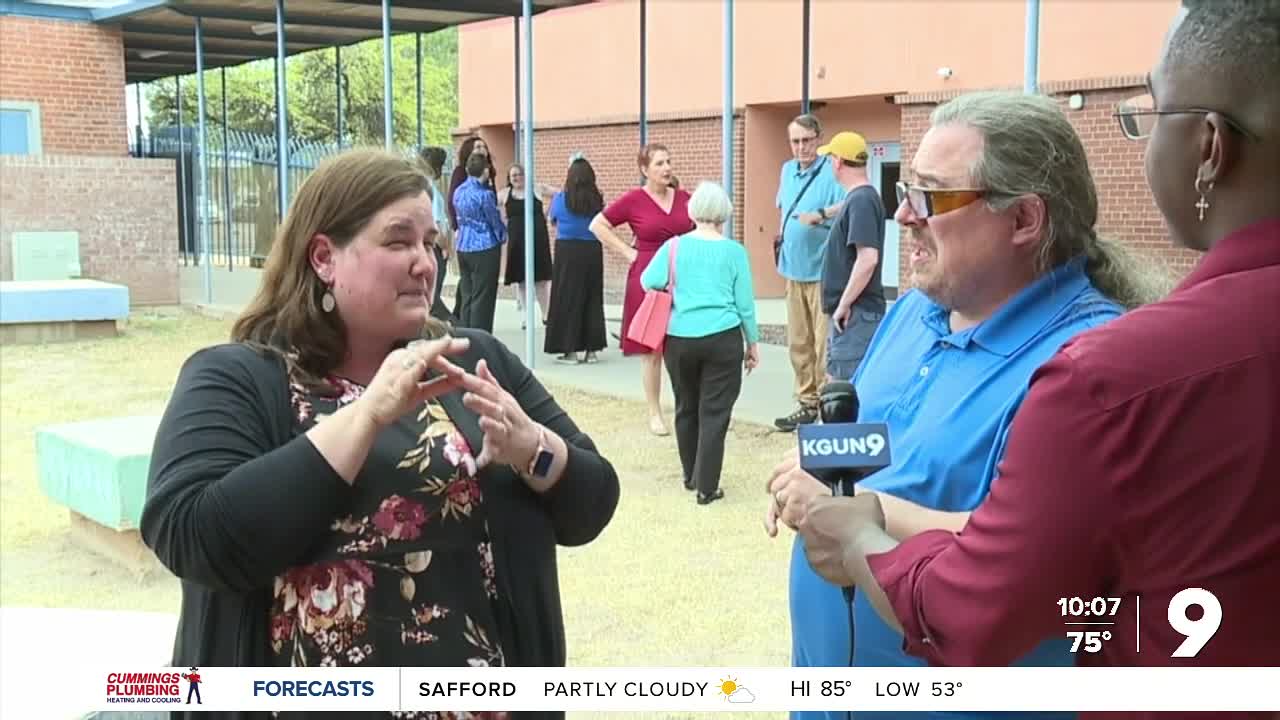


TUCSON, Ariz. (KGUN) — Catherine Sienko felt that, as president of the Arizona Association of the Deaf, she needed to come to the Tucson Unified School District's governing board meeting to speak for Arizona State Schools for the Deaf and the Blind students, she says, could not speak up for themselves.
Sienko said she asked for an interpreter days in advance to ensure she could participate, but when she walked up to the podium expecting her accommodation to be honored, no one was there.
"I have shown up here in a space with no interpreter, a room full of hearing people who don't know sign, asking a friend to interpret for me. How does that make us feel comfortable that the deaf, hard-of-hearing students who will go to your schools will not feel isolated?" Sienko said.
The Tucson Unified School District is now delaying a vote on $815,000 in funding to support initiatives for students of the Arizona State School for the Deaf and Blind after failing to provide an American Sign Language interpreter at Tuesday's meeting.
The board halted its decision when the district could not provide an interpreter for deaf community members who attended to speak out against the funding plan.
The board responded by saying their interpreter had a last-minute conflict, before deciding to delay the vote.
"This is the first time that we've had a member of the deaf community come and address the board," Boardmember Natalie Luna Rose stated.
"But I do apologize for not having an ASL interpreter. Now that we are going to be working with students from ASDB, we will make sure there's an interpreter here at every board meeting."
Board member Sadie Shaw chimed in, expressing frustration over the lack of an interpreter.
"We really need to do better as a district," Shaw said. "I'm super ashamed and upset about what is happening at this governing board meeting today. I'd like to add to a future agenda a view of our policies regarding interpretation."
When the district had no one else available, Sienko's colleague, Arizona Association of the Deaf Southern Arizona Representative Thor Halvorsen, had to step in and interpret for her, despite not being a professional interpreter himself.
KGUN 9 spoke with both of them about their concerns earlier in the day.
"The concern is how the deaf, hard-of-hearing students can grow at TUSD, especially with personal growth. That's why they originally were set apart at ASDB," Sienko said.
Deaf ASDB students are relocating to the former Copper Creek Elementary school building in Oro Valley, but Sienko worries about those who cannot make the commute and whether TUSD is ready for their needs.
"We have to provide services, interpreters, teachers of the deaf, specialists of the blind," Sienko said.
Sienko said ASDB offered in-house services that helped students grow, which she believes TUSD may not be able to match.
"How can Tucson Unified School District do that if deaf, hard-of-hearing students don't have the same living experience as their hearing peers?" Sienko said.
The proposed $815,000 would be used to make TUSD more accessible for the influx of ASDB students being fed into their district next year, with $515,222 meant for extra staff and training, and and $300,000 going toward new technology, learning materials, and accessibile buildings and classrooms.
Now that the vote is delayed, the board plans to meet again to find another date where they can have an ASL interpreter to accommodate everyone's needs.
—
JJ McKinney joined KGUN 9 in July of 2025 as a multimedia journalist. He graduated from Colorado State University in May of 2025 with a degree in journalism and media communications and a minor in law. With a background in investigative reporting and documentary filmmaking, JJ is dedicated to giving a platform to the voices of his community. Share your story ideas and important issues with JJ by emailing jj.mckinney@kgun9.com or by connecting on Instagram, Twitter, or Facebook.


