

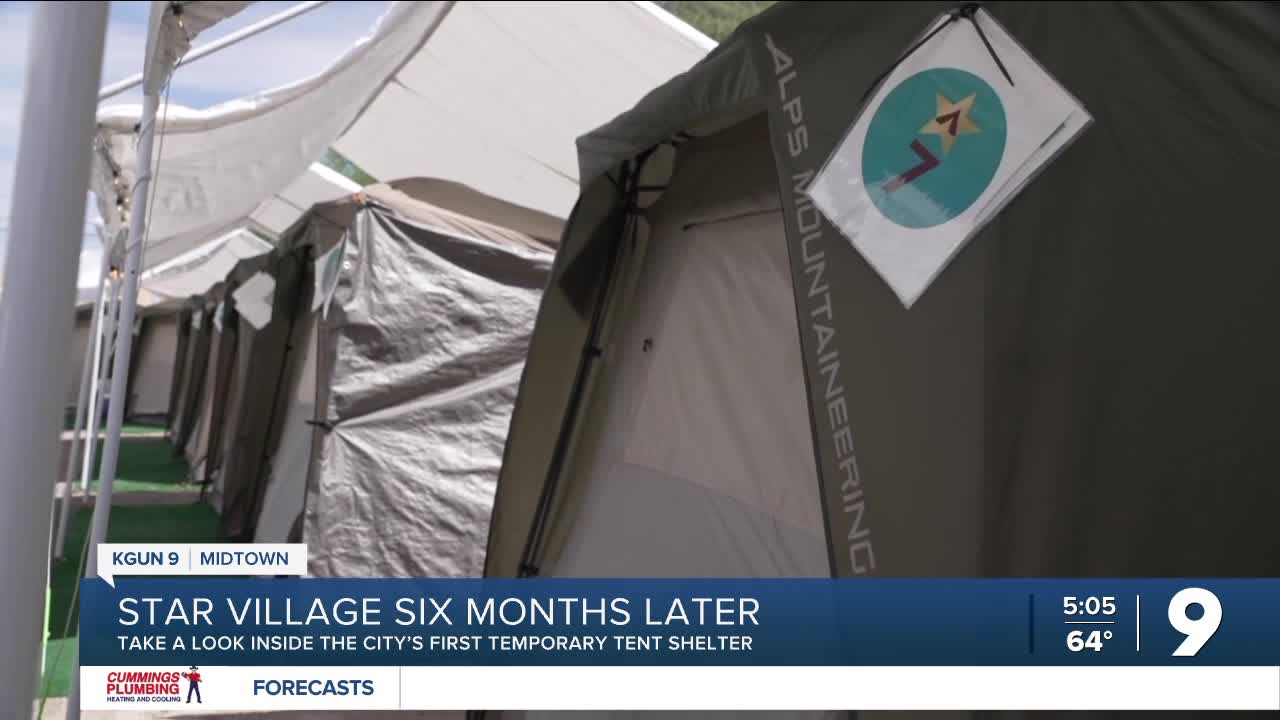


TUCSON, Ariz. (KGUN) — For the past three months, Robyn Carte has ended her days in a 64-square-foot tent. Inside, there's just enough room for bedding and some storage.
“I’m elated," she said, "and just don’t know how to express my thanks.”
Before moving into STAR, Carte spent her nights sleeping on the streets. Now, she says, she's close to a permanent, indoor home of her own.
Carte's story isn't unique. Her tent bookends a short line of identical tents. Inside each of those is a similar story.
Since STAR Village—Tucson's first temporary tent shelter— first opened its gates in October, 82 women have spent the night behind the covered chain-link fence.
Each STAR resident is provided with a covered tent, bedding and clothing. While living in the 25-tent village, they're offered a rotating cycle of services to help work towards a more stable future.
“We knew that there needed to be something between coming off the streets and getting into temporary shelter, and that was STAR Village,” said Tisha Tallman. Tallman is the CEO of the Primavera Foundation, one of the city of Tucson's nonprofit partners responsible for operating STAR Village.
Now at the pilot project six-month checkpoint, Tallman says all of the current residents all have concrete pathways towards housing. However, each person's timeline looks different.
“We’ve learned that people need more adjustment period depending on how long they’ve been on the street or in an encampment.”
During that period, each resident has a caseworker helping them get their government documents in order, apply for benefits or enroll in work programs or treatment programs for drug use and mental health concerns.
All of that starts with a safe place to stay.
“I’ve just been grateful because I didn’t have to lose all my stuff again," Carte said. "It’s hard when you lose your stuff. I’ve lost it either by not being able to pay my storage fee or just being out there, and they demolition a site.”
With a safe place to sleep, not only is she able to keep her belongings safe, but she's able to start stocking up for her future. Carte says she's already picked out a few decorations for her future kitchen.
As STAR hits its halfway mark, Tallman says a few things have changed around the lot.
The original tents were replaced by an anonymous donor with larger tents, allowing the occupants to stand up, and the tent occupants themselves have changed too.
Tallman says out of their current residents, half came into the program when it first opened, called "the originals."
Despite the changes, the pilot project's mission has stayed the same.
“When community comes together—city, non profits, neighborhoods, communities at large— we can really achieve some great things,” Tallman said.
A mission that organizers and residents hope to spread to other areas of Tucson.
“There’s a lot of people out there that need their help," Carte said. "Just come here open, and the whole world will be opened up to you if you allow it.”
——
Alex Dowd is a multimedia journalist at KGUN 9, where her work combines her two favorite hobbies: talking to new people and learning about the community around her. Her goal is to eventually meet every single person in Tucson. Share your story ideas with Alex via email, alex.dowd@kgun9.com, or connecting on Instagram or X.


