

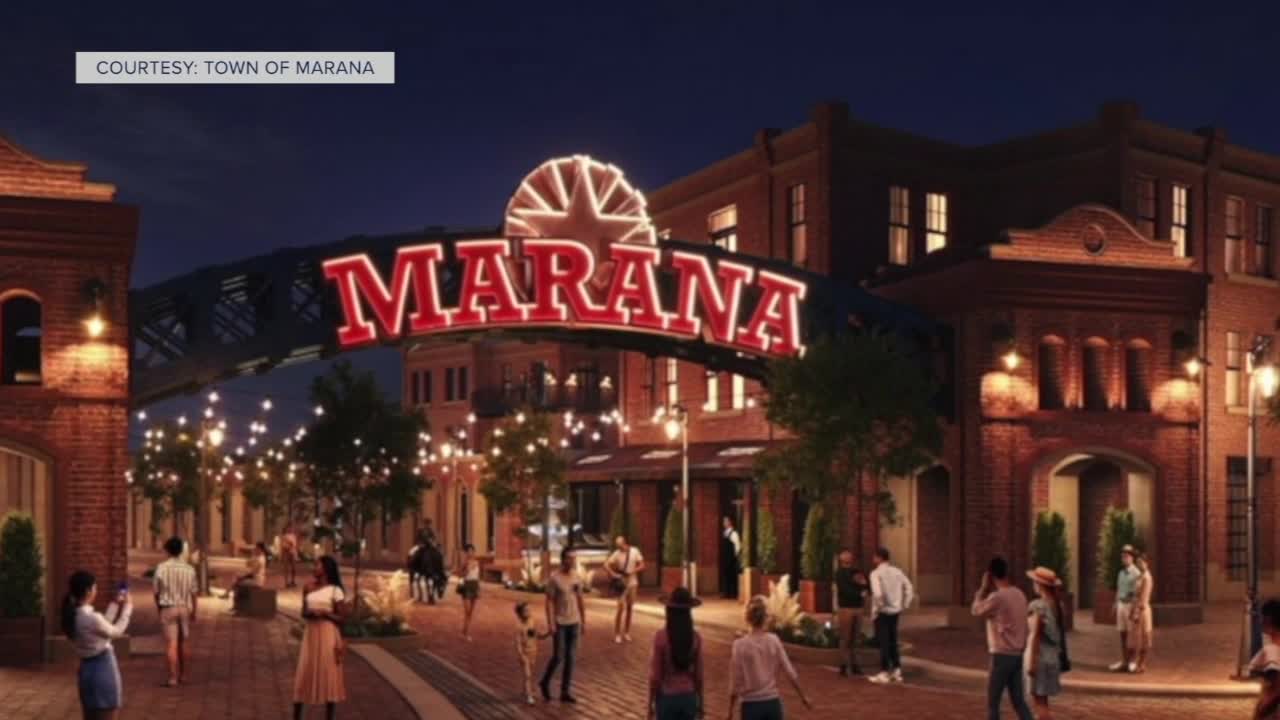


MARANA, Ariz. (KGUN) — After months of legal challenges, Marana's long-planned downtown entertainment district is officially moving forward, with construction on the first phase expected to begin in late 2027 or early 2028.
The Arizona Supreme Court recently denied a petition to review the project, closing out a legal fight that began earlier this year when the group Arizonans for Responsible Development sued the town, arguing the development agreement should have gone before voters as a referendum. Lower courts had already ruled against the group, finding that approving a development agreement is an administrative action, not a legislative one, and therefore not subject to referendum.
KGUN 9 first reported on the legal battle earlier this year as the petition made its way through the courts.
For Marana Town Manager Terry Rozema, the news that the fight was finally over triggered an outsized reaction.
"I literally stood up in my office yelling, 'yes, yes, yes,' screaming at the top of my lungs, pumping my fists as I walked around the office, and people came running to find out what I was yelling about," Rozema said. "It's exciting. We couldn't be more excited."
What's being built
The project will transform roughly 20 acres of town-owned land near Marana Main Street and Civic Center Drive into a mixed-use entertainment district featuring restaurants, retail, a hotel and public gathering spaces. The full build-out is expected to include about 12 buildings across at least two, and possibly three, phases.
Design work is already underway on phase one, which will consist of three buildings.
"Design will take roughly a year, could be a little bit more, maybe 15 months or so," Rozema said. "So I think we can anticipate the latter part of 2027 to the very beginning of 2028, shovels in the ground."
Rozema said the second phase will depend largely on how the first performs.
"One phase will come after the other, and the second phase will be largely dependent on the first phase — how successful it is, how well things are going, and what people are asking for and wanting in their downtown," he said.
Residents, Rozema said, have been especially vocal about one gap in North Marana.
"We need some sit-down restaurants up here in North Marana, because we don't have very many," he said. "So to have some places where you can go and grab a meal with your family, a nice sit-down restaurant, something that's unique, distinguishable from your chain restaurants — I think is something that people are really excited about and looking forward to."
Beyond the businesses themselves, Rozema said the project is meant to give the town something it currently lacks: a defined center.
"It's going to give our residents a sense of place, a place to gather, a place they can call their downtown, a place they can be proud of," he said. "I think those are all things worth having in a community."
How the developer was chosen
The town issued a request for proposals in May 2024 seeking a developer to lease and build out the town-owned land. Marana Urban LLC was the only company to respond. A town evaluation committee — made up of staff from development services, economic development, the town manager's office, water and legal — reviewed the proposal and requested additional information, including a preliminary infrastructure cost estimate.
In November 2024, the committee recommended the town begin formal lease negotiations with Marana Urban LLC. The Marana Town Council approved the final lease agreement on Dec. 16, 2025. A referendum petition against the project was filed the following month, triggering the legal fight that concluded with last month's Supreme Court decision.
Who's behind the project
Marana Urban LLC is led by Scott Stiteler, who began developing infill residential projects in the San Francisco Bay Area in 1990 before expanding into Tucson in 1994. He has developed roughly 25 projects in the Tucson area, including the Mercado District, the renovated historic Rialto building downtown, the AC by Marriott hotel downtown, and several restaurant and bar concepts such as The Hub and Playground.
His project team includes Rudy Dabdoub, a longtime real estate and hospitality executive; Regan Jasper, a founding partner of Fox Restaurant Concepts; and Cory Creath and Ruairi O'Connell of AXIS Architecture + Design.
Stiteler's company separately owns 40 acres directly north of the entertainment district site, where it plans to build five-story, high-rise buildings with retail and commercial space on the ground floor — a distinct project from the downtown district itself.
What it will cost — and who's paying
Under the agreement, the town is responsible for public infrastructure — utilities, parking, the brick roadway and archways — funded primarily through the town's bed tax fund, which is restricted to tourism-related projects, and the Downtown Marana Reinvestment Fund, which can only be spent on the downtown district. The total infrastructure cost hasn't been finalized; the developer will provide a cost estimate for phase one before construction begins, and that figure will then be capped for that phase.
The town will not be funding the commercial buildings directly. Instead, it will reimburse Marana Urban LLC over time using a share of sales tax revenue generated on the property — 45% of retail sales tax and 75% of construction sales tax collected there. The estimated cost to construct the commercial buildings, in 2025 dollars, is $84 million.
The town says that figure isn't a check written to the developer up front. As buildings are completed, the developer must submit documented construction costs, and the town reimburses those costs over time only as retail and construction sales tax revenue comes in from businesses operating on the property.
The developer will own and maintain the buildings during the lease term. When the lease expires or terminates, ownership transfers to the town at no additional cost. According to a town-commissioned appraisal, those buildings are projected to have a depreciated reversionary value of about $362.9 million after 75 years and $477.5 million after 100 years.
A separate third-party analysis by Elliott D. Pollack & Company projects the project will generate about $37.5 million in direct tax revenue for the town over the first 20 years of the lease, $180.1 million over 75 years, and $244.9 million over 100 years — resulting in a projected net fiscal benefit to the town of $96.1 million to $160.9 million.
Rozema said the roughly seven-month legal fight added an estimated $100,000 in legal costs but didn't materially change the project's scope or budget.
"All of the things that we're doing now are things that we had planned to do back in January," he said. "It's just kind of pushed back nine months or so."
Community and market reaction
KGUN 9 also spoke with residents and business owners about the project, including a realtor with The Collective at Dove Mountain, who said one of the most common questions she fields from clients is what there is to do in Marana. She said she believes the entertainment district could finally answer that question — for both current residents and prospective buyers weighing a move to the area.
Rozema said the project is also part of a broader effort to give Marana a distinct identity as it continues to grow.
"When people talk about Tucson, they kind of talk about everything in this area as Tucson," he said. "The goal here is obviously to distinguish ourselves and separate ourselves from the standpoint that we are a separate community with a different identity."
No firm completion date has been set for the full build-out. The design phase for phase one is expected to take 12 to 18 months, with construction on phase two to follow based on how the first phase performs.
----
STAY IN TOUCH WITH US ANYTIME, ANYWHERE


