

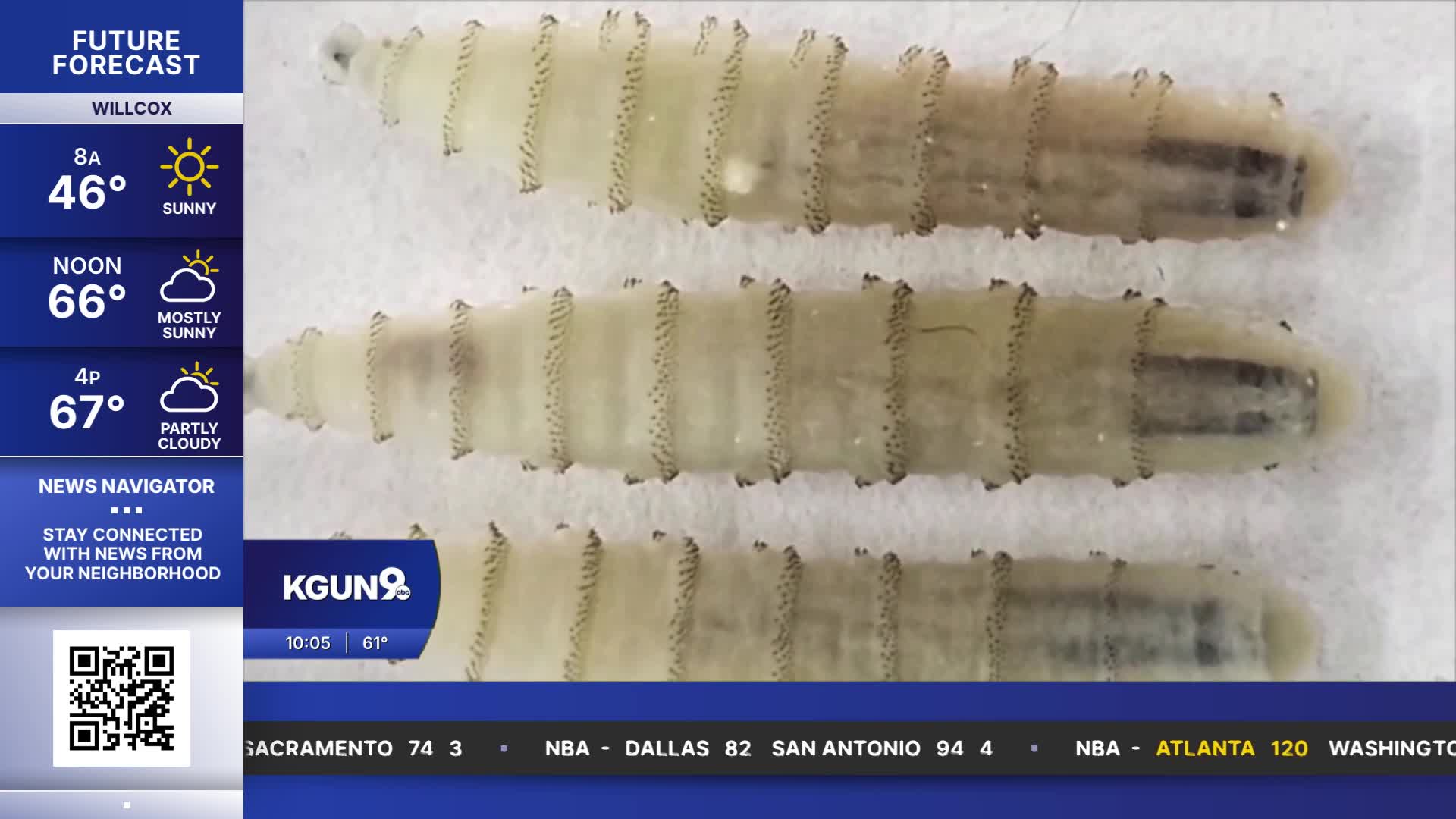


SIERRA VISTA, Ariz. (KGUN) — The Arizona and U.S. Department of Agriculture are developing a plan of action after New World Screwworm was detected in Cochise County, following the report of an infected horse near Hereford.
State and federal officials are now working with ranchers, veterinarians, and community members to prevent any more cases.
New World Screwworm is an invasive parasitic fly whose larvae burrow into the living tissue of warm-blooded animals.
Adult flies are drawn to the scent of fresh wounds and openings on a living animal's body. Once an infestation takes hold, the larvae begin consuming tissue.
Without treatment, a full-grown animal can die in as little as 10 days. The pest can affect livestock as well as companion animals such as cats and dogs.
Cochise County is one of several counties across the southwestern United States currently reporting cases.
In response, the state is establishing a 12-mile infested zone around affected animals in southern Arizona.
Any animal confirmed to be infected will be placed under a 21-day quarantine. Animals in the surrounding area will not be permitted to move without state approval.
Devon Kartchner, Arizona's Assistant State Veterinarian, said the state's primary tool for eliminating the pest is a sterile insect technique — a process that involves releasing sterile flies into affected areas to disrupt the screwworm's ability to reproduce.
"Our sterile insect technique and dispersal of sterile flies is what actually can eliminate that pest from the environment," Kartchner said.
Movement restrictions are also central to the containment effort.
"The movement controls is going to help to slow down the spread of new screwworm to new areas that are not currently infested," Kartchner said.
The state expects screwworm removal efforts to extend into 2027. Kartchner said the process requires patience, but has a track record of results.
"It's a slow process, but it does work. It's proven to work in the past. And that's how we're going to eradicate it from the United States." Kartchner said.
Cattle ranchers and horse rescuers Steve Boyce and Theresea Warrell said the discovery has them watching their animals closely and preparing for the possibility of further spread.
Warrell said the potential impact on their operation is significant.
"That's our business. That's our livelihood. We're trying not to be in panic mode, but be prepared and ready to do the things we need to do," Warrell said.
Boyce said he remembers one of the last times screwworm was present in Arizona during the 1970s and the damage it caused to animals at that time.
"It's very devastating and it's very parasitic. And it's just hard to deal with it." Boyce said.
Veterinarian Gary Thrasher said he has treated animals affected by screwworm firsthand. He said the damage to an animal's tissue can compound quickly.
"They start eating live tissue, and they can do a lot of damage, making wounds a whole lot worse," Thrasher said. "We had it in all our animals. A lot of horses still have scars."

The USDA is asking animal owners across the region to monitor their animals for signs of infestation. Symptoms to watch for include large or unusual wounds, the presence of maggots and visible signs of discomfort in an animal.
—
JJ McKinney joined KGUN 9 in July of 2025 as a multimedia journalist. He graduated from Colorado State University in May of 2025 with a degree in journalism and media communications and a minor in law. With a background in investigative reporting and documentary filmmaking, JJ is dedicated to giving a platform to the voices of his community. Share your story ideas and important issues with JJ by emailing jj.mckinney@kgun9.com or by connecting on Instagram, Twitter, or Facebook.


