

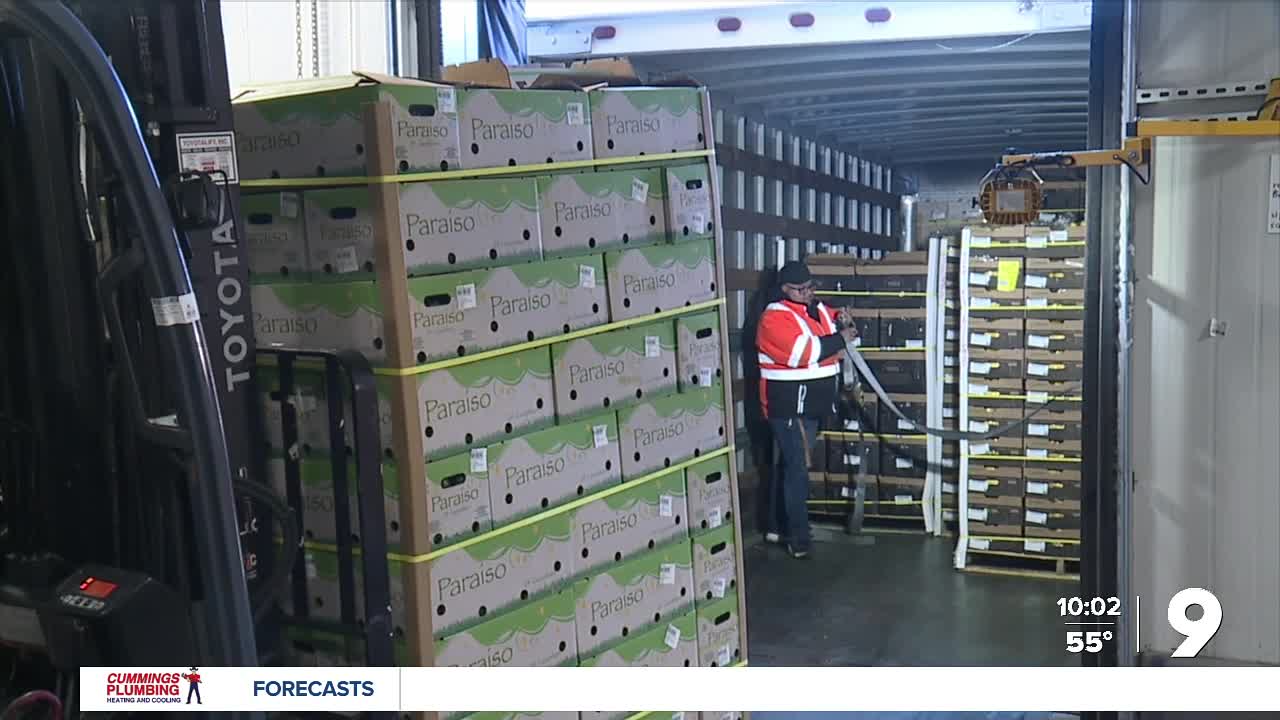


NOGALES, Ariz. (KGUN) — The USMCA governs trade among the three countries and must be reviewed every six years. For produce distributors in Nogales, the agreement plays a key role in keeping goods moving across the border without added costs.
“All this produce comes from Mexico,” said Jaime Chamberlain, president of Chamberlain Distributing Inc. “Anything under the USMCA agreement does not pay any tariffs.”
The agreement does not require companies to maintain offices or employees in another country in order to trade, allowing U.S. businesses to work directly with Mexican producers. Chamberlain said those relationships are essential to his company’s operations.
“I have a very strong relationship with my farmers and all the partners that we have down there,” he said.
USMCA rules also require that changes to trade regulations be transparent and based on objective factors, such as environmental or public health concerns. Chamberlain said continued communication between industry leaders and government officials is critical.
“We have to continue to educate our administrations as to what the values are to the supply chain that we bring each other,” he said.
Chamberlain also serves as vice chairman of the Greater Nogales Santa Cruz Port Authority, which supported the agreement’s adoption, and recently talked with the United States Trade Representative. He said the USMCA benefits consumers by ensuring a steady, year-round supply of produce.
“We honestly believe that we bring a tremendous value to the U.S. consumer, not only in the quality that we bring in, but the consistency of which we bring in our products,” he said.
President Donald Trump, who signed the USMCA into law in 2020, recently suggested the U.S. could allow the agreement to expire or renegotiate its terms with Mexico and Canada. Chamberlain said uncertainty around the agreement could affect sectors beyond produce, including water, cattle and labor.
“All of those little issues will end up affecting us in the long run,” he said.
Pima County Economic Development Director Heath Vescovi-Chiordi said letting the agreement lapse would create challenges for local governments and businesses trying to plan for the future.
“We wouldn’t be able to predict a lot of different things,” Vescovi-Chiordi said. “I think it would also kind of inhibit figuring out how to engage with our partners and how we specifically do supply chain.”
Vescovi-Chiordi said Pima County is already working to strengthen economic ties with Mexico and believes renewing the USMCA would help expand trade opportunities, particularly for smaller businesses.
“It would allow those small and medium-size enterprises to access those supply chains and those manufacturing chains a lot easier,” he said.
According to the Office of the U.S. Trade Representative, U.S. goods exports and imports with USMCA countries increased in 2022 compared with 2021.
——-
Andrew Christiansen is a reporter for KGUN 9. Before joining the team, Andrew reported in Corpus Christi, Texas for KRIS6 News, Action 10 News and guest reported in Spanish for Telemundo Corpus Christi. Share your story ideas with Andrew by emailing andrew.christiansen@kgun9.com or by connecting on Facebook, or Twitter.
