

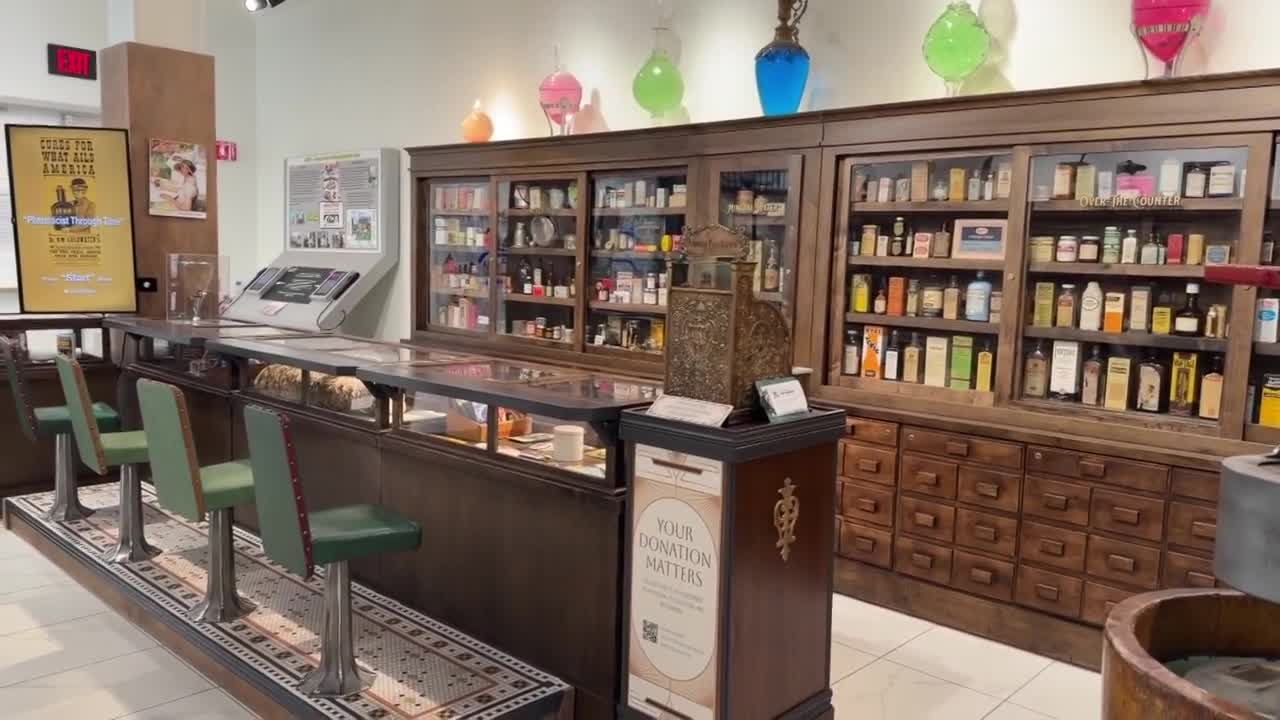


The University of Arizona is home to one of the world's leading museums of its kind, and it's one that you've likely never heard of.
The Coit Museum of Pharmacy is celebrating 60 years on campus. It sits tucked away in the Pharmacy building, just south of Banner - University Medical Center at Speedway and Campbell.
"We actually get a lot of people stumbling across this," said Heather Ingram, museum director. "They're absolutely amazed. They have no idea. There's not a lot of pharmacy museums in the United States. So, we're one of those rare museums mostly dedicated to pharmacy."

It is home to more than 60,000 pieces of pharmacy history, many of them displayed in a modern setting.
The American Institute of the History of Pharmacy says Coit Museum has the best pharmacy collection in the country.
So how did this massive collection end up at the U of A?
It's all due to a Tucson pharmacist named Jesse Hurlbut.

"He owned Owl Drug downtown in the 1930s to 1950," Ingram said. "During that time, he collected. He would meet up with pharmacists all over the state of Arizona. People who were closing up shop. People who had things in their basements or attics. So, he began collecting Arizona pharmacy history."
With encouragement from his wife, Mary, Hurlbut decided his massive collection needed to be seen.
"He worked with the U of A to donate it in honor of the university's 75th anniversary in 1966," Ingram said. "So, we're 60 this year."

His pharmacy artifacts were originally displayed in various public spaces throughout the College of Pharmacy.
Five years ago, thanks to the generosity of alumnus R. Ken Coit, the Coit Museum of Pharmacy & Health Sciences opened, housing what has become one of the world's leading collections of pharmaceutical artifacts.
A visit to the museum begins with a very special part of the collection: A series of items from the Upjohn Pharmacy on Main Street in Disneyland.
It's what Ingram calls the jewel of the museum's crown.

"It was a turn-of-the-century pharmacy," Ingram said. "It wasn't a working pharmacy, but they did have pharmacists on staff who would demonstrate compounding and answer questions."
The Disneyland Pharmacy display includes ornate items and turn-of-the-last-century pharmacy products.
"I like pointing out the anti-asthma cigarettes," Ingram said.
Then there's the opium poppy jar.
"You can see that they actually used imagery: before you have your opium and after you have your opium," Ingram said. "Remember, that's in a time when opium was legal."

Among some of the other artifacts is a massive display of mortar and pestles.
And they are constructing a soda fountain display, similar to the one Jesse Hurlbut had in his Owl Drug in Downtown Tucson.
It includes one of the most unique items in the collection, part of the John Dillinger story in Tucson.
Before the 1934 fire at Hotel Congress and the capture of Dillinger and his gang here in Tucson, Dillinger visited Owl Drug.

He purchased a pack of Black Jack gum.
When he sat down to eat at Hurlbut's counter, Dillinger stuck his gum underneath the counter.
"(Hurlbut) collected that gum, and so that's one of the most popular things in our collection," Ingram said. "You can see the chewed gum, which is a little gross. But some of this, not all of it, is John Dillinger's. How would you know which gum it was?"
The Coit Museum of Pharmacy, in the Skaggs Pharmaceutical Sciences Building, 1703 E Mabel St, Room 260, is free and open Mondays, Wednesdays and Fridays, from 9 a.m. to 3 p.m.
——-
Pat Parris is an anchor and reporter for KGUN 9. He is a graduate of Sabino High School where he was the 1982 high school state track champion in the 800 meters. While in high school and college, he worked part-time in the KGUN 9 newsroom. Share your story ideas and important issues with Pat by emailing pat.parris@kgun9.com or by connecting on Facebook, Twitter, and Instagram.

