



TUCSON, Ariz. (KGUN) — Once one of the richest men in the world, Howard Hughes was a pioneer in aviation, Hollywood filmmaking and in business.
What does the man best remembered for the Spruce Goose and his bizarre eccentricities have to do with Tucson? If it weren't for Hughes, there would be no Raytheon.
It all began when Charles Lindbergh inspired a nation with his transatlantic flight in 1927 from New York to Paris. He also inspired a 21-year-old from Houston named Howard Hughes.

"When Charles Lindbergh flew across the Atlantic Ocean and into fame and adoration, Howard Hughes decided he wanted a piece of that action," said award-winning Tucson historian David Leighton.
Leighton has done extensive research on Howard Hughes. He says six months after Lindbergh's historic flight, Hughes earned his pilot's license just in time to start production of his epic war movie, "Hell's Angels."

"He actually flew a plane, and helped actually direct the air battles himself, which was a result of him getting his pilot's license," explained Leighton.

Released in 1930, "Hell's Angels" is still considered a landmark in filmmaking.
Hughes then turned his attention to aviation. In 1935, with his new Hughes Racer, he set the world airspeed record.
"This results in him forming the Hughes Aircraft Company in 1936," Leighton said.
Based in Culver City, California, Hughes Aircraft was busy building experimental planes during World War II. Planes like the Hughes H-4 Hercules, better known as the Spruce Goose, which briefly flew during a test flight in 1947.

The Spruce Goose was the largest seaplane ever built, but never advanced beyond the prototype. Hughes Aircraft was also developing other projects for the U.S. War Department.
"This experimental work eventually leads some scientists to start working on what becomes guided missiles," said Leighton. "It's the actual guided missiles from the department and Hughes Aircraft Company that led to, in 1951, Hughes coming to Tucson."
The U.S. was in the midst of the Korean War. Hughes wanted to move his missile production facility away from the coast. Roy Drachman and Axel Johnson secretly worked to convince Hughes to select Tucson as the home for its missile production.
"To a certain degree, those two guys are why we have Hughes and now Raytheon here," Leighton said.
Leighton took KGUN 9 to the beginnings of Hughes Aircraft in Tucson, near the three large hangars on the west side of the airport.
"There was a wooden warehouse here with a concrete floor that's still here," Leighton explained. "This is where the original 35 Hughes employees actually got trained. It was also where, through the railroad tracks here off Nogales Highway, they brought in raw supplies to actually build the main building at what's now Raytheon."
Hughes purchased nearly 2,500 acres of land. Throughout 1951, the Dell Webb Construction Company built what is now known as Building 801.

The main focus of Hughes Aircraft at the time was air-to-air missiles.
"The development of the Falcon missile." said Leighton. "They wanted to produce the Falcon missile which was the first effective air-to-air guided missile."
By 1956, Hughes employed 5,000 people. By 1960, Hughes had produced 30,000 Falcon missiles.

From the Falcon, to the Phoenix, to the Maverick, they were all developed and produced at the Hughes production facility in Tucson.
In 1997, Raytheon acquired Hughes. A 2020 merger with United Technologies gives us the name RTX, but the mission remains the same.
"This is actually the largest missile manufacturing facility in the entire world," said Sam Deneke, President of Air & Space Defense Systems for Raytheon.

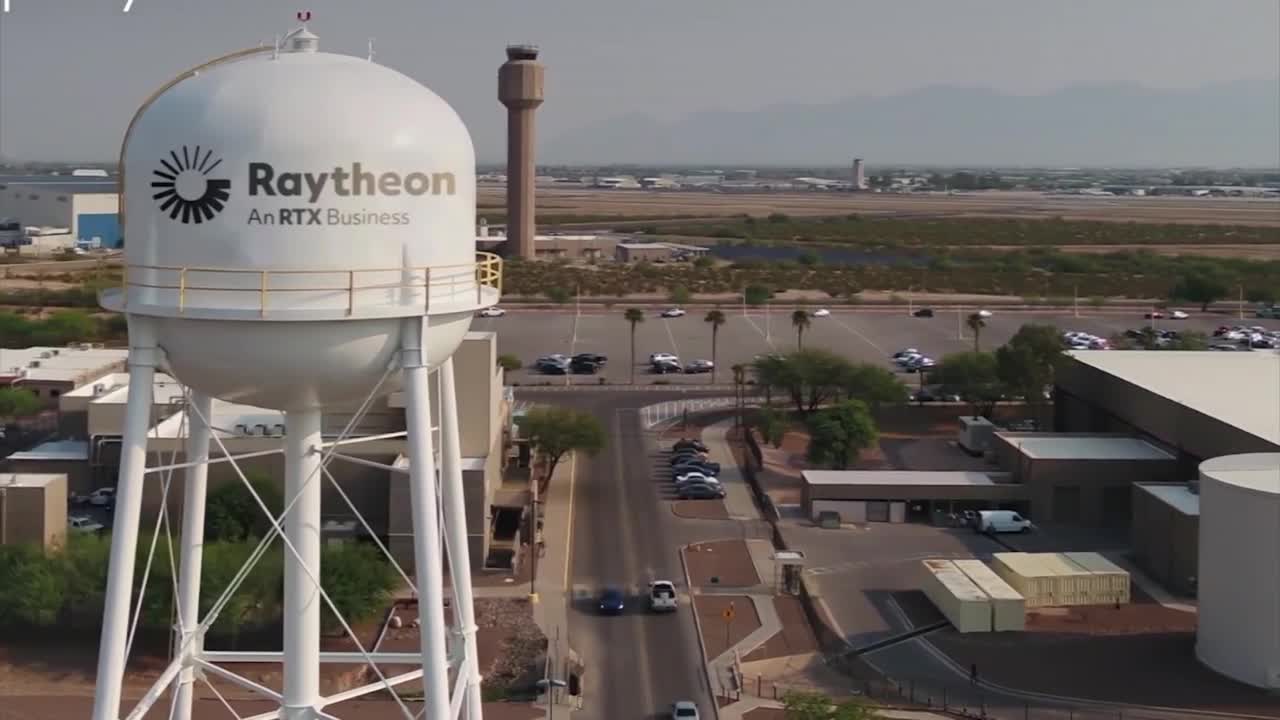
Today, Raytheon is Tucson's largest private employer with nearly 13,000 people working at the facility. It generates billions of dollars in economic impact in Arizona each year.
While air-to-air missile production continues, Deneke tells KGUN 9, missile defense has become a much larger part of their efforts.
"The munitions that go up and defend areas from incoming missiles, we've seen tremendous growth in that area," said Deneke. "In particular, Tucson is really the epicenter of that growth."
Much of the Raytheon facility is actually owned by the Department of War, and has been since 1951, showing the deep connection between Tucson and our national defense.

Deneke showed KGUN 9 new video technology that Raytheon uses to demonstrate these missile defense systems to allies looking to purchase them.
Along with the use of artificial intelligence, Howard Hughes likely would not recognize much of what Raytheon and RTX do now compared to 75 years ago, when this plant opened.
"He would be amazed at the amount of growth and the fact they we're employing almost 13,000 people here," said Deneke "I think he'd be pretty proud of where we are."
——-
Pat Parris is an anchor and reporter for KGUN 9. He is a graduate of Sabino High School where he was the 1982 high school state track champion in the 800 meters. While in high school and college, he worked part-time in the KGUN 9 newsroom. Share your story ideas and important issues with Pat by emailing pat.parris@kgun9.com or by connecting on Facebook, Twitter, and Instagram.
