

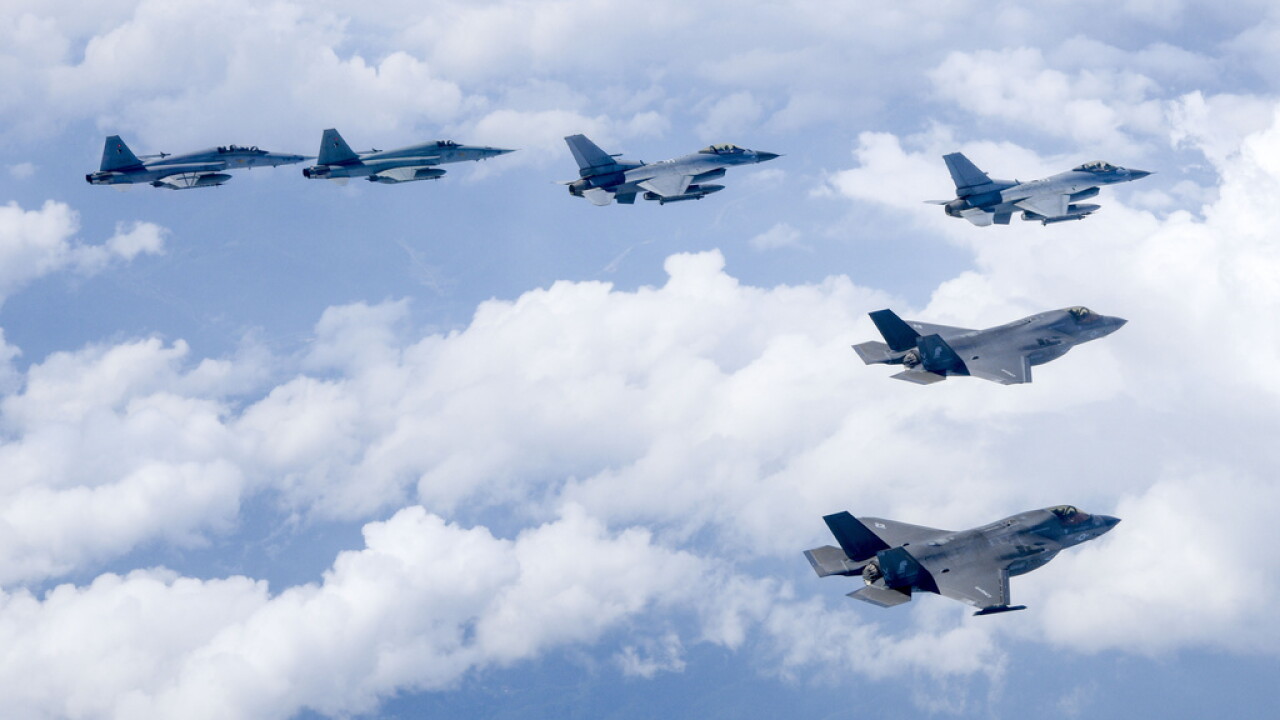


Lt. Gen. Jay Bargeron, the Marine Corps' deputy commandant for plans, policies and operations, told Scripps News joint exercises with allies remain a critical part of U.S. military strategy despite recent reductions in major drills with South Korea.
A senior Marine Corps official on Wednesday emphasized the importance of joint military exercises with allies, even after the Trump administration moved this month to scale back major training events with South Korea.
Lt. Gen. Jay Bargeron, the Marine Corps' deputy commandant for plans, policies and operations, said combined exercises remain essential for maintaining interoperability and strengthening relationships with partner nations.
"Joint and combined exercises are hugely important," Bargeron told Scripps News. “We will always be relying heavily on them, and we'll always be pressing for them."
Bargeron’s comments come days after President Donald Trump directed the Pentagon to reduce participation in annual military exercises with South Korea, citing both his strong relationship with North Korean Leader Kim Jong Un and disagreements with South Korean leaders over their unwillingness to participate in U.S. operations targeting Iran.
Trump's move limited U.S. participation in Ulchi Freedom Shield, the latest version of an annual U.S.-South Korean exercise series that traces its roots to 1976. South Korean officials, for their part, have said the U.S. canceled participation in the upcoming Ssangyong amphibious exercise because Marine Corps forces were constrained by requirements in the Middle East.
Asked how the reductions fit with the Marine Corps' long-term strategy, Bargeron acknowledged that exercise levels can fluctuate but said cooperation with allies would remain an enduring priority.
The remarks came during a discussion of the Marine Corps' newly released Ground Combat Element 2040 framework, a long-range planning document intended to guide development of the service's future ground forces over the next decade.
The document repeatedly highlights the importance of joint and allied operations, calling for "joint integration by design, not adaptation." It also describes future Marine formations as forces capable of "Joint and Combined integration" and says Marine Littoral Regiments are being optimized for "Joint kill-web integration" in contested environments.
The strategy argues that access to strategically important terrain "will not be automatically granted by allies and partners" and emphasizes exercises, security cooperation and interoperability as essential tools for maintaining those relationships. "Trust is a cultivated asset that cannot be surged," the document states.
More broadly, the GCE 2040 framework envisions a future Marine Corps built around distributed operations, long-range precision fires, expanded air defenses, increased use of artificial intelligence, autonomous systems and deeper integration with the naval and joint force.
The strategy's ambitions raise questions about cost and whether future defense budgets will be sufficient to fund its goals. President Donald Trump has proposed a record $1.5 trillion defense budget for 2027, though such funding levels could only be reached if lawmakers approve additional funding through the budget reconciliation process in addition to traditional defense appropriations.
Some lawmakers in both parties have expressed doubts as to whether Republicans’ will be able to push through a reconciliation package with the figures Trump requested.
Asked about such budget concerns, Bargeron said “predictable funding is desired," but added that Marines will "take whatever funding we get" and make the most of it.
Bargeron said the framework's phased approach is designed to allow the service to pursue modernization goals incrementally while adapting to available resources.
"We will optimize it just like we do the training," he said.
