

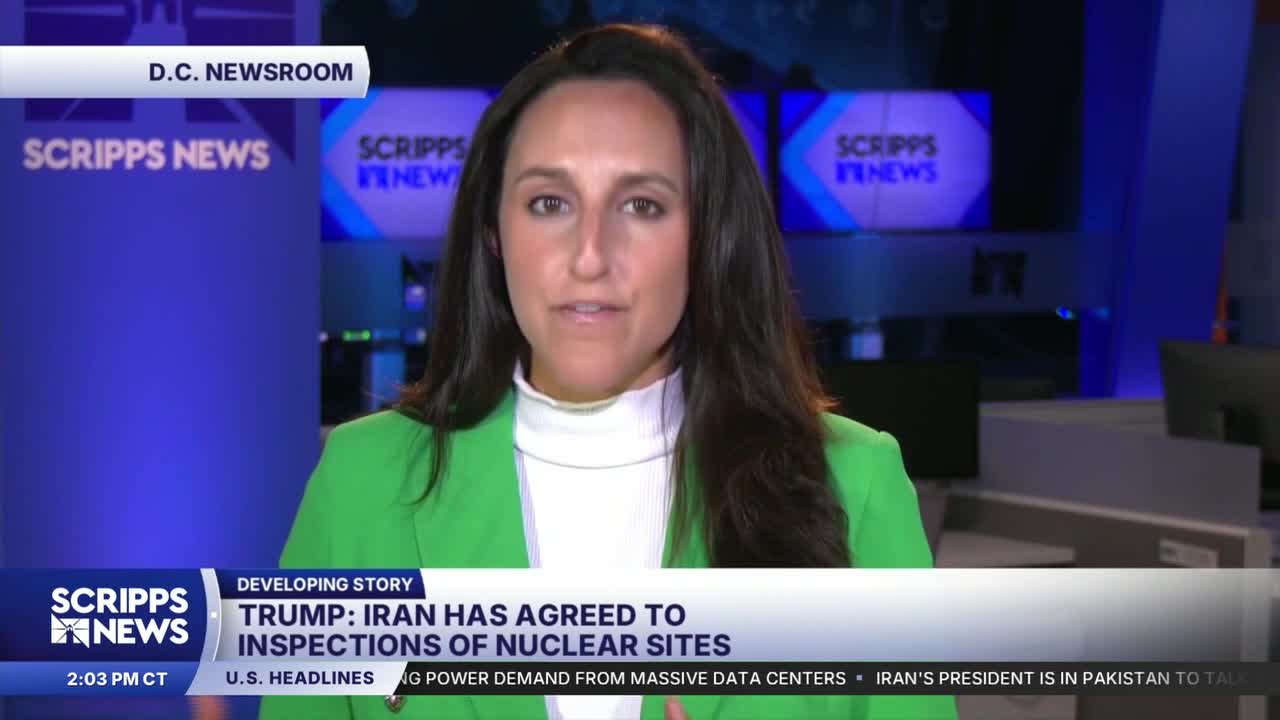


The White House and Iran were sending conflicting messages Tuesday, highlighting points of disagreement as negotiators seek a longer-lived peace agreement.
Nuclear inspections
While President Trump and Vice President JD Vance say Iran has agreed to allow nuclear inspectors from the International Atomic Energy Agency into the country, the Iranians are rejecting the notion that those inspectors have been invited to see the sights of us bombings of nuclear facilities last year.
Returning inspectors to Iran would be a significant breakthrough. President Trump has insisted it will happen, and warned of consequences for Iran if it doesn't cooperate.
On social media, President Trump wrote "despite their protestations and false statements to the contrary, coupled with the drumbeat of the Fake News, which is doing everything possible to make the U.S. Victory a small and insignificant as possible. Iran is fully and completely agreed to highest level Nuclear Inspections long into the future (Infinity!!!)"
He went on to say if they didn't, there would be no further peace negotiations.
Use of frozen Iranian funds
President Trump also says any and frozen Iranian assets will be controlled by the U.S. And Qatar to purchase U.S. goods, such as agricultural products. Iranian officials are maintaining they will decide the use of those funds, acknowledging only that they need technical agreements from the U.S. And Qatar for those mechanisms.
The future of the Strait of Hormuz
President Trump has maintained that the Strait of Hormuz will be toll free for the initial 60-day negotiating period, something Iranians have also signaled.
U.S. officials also expect that toll-free component to be a part of any final deal. But the Iranians, in a joint statement with Oman, have suggested they may seek fees from passing ships again. In a statement, Iranian officials wrote that they would continue talks in a joint working group to "reach agreement on the future administration of navigation in the Strait of Hormuz and the services that will be provided in this regard."
RELATED STORY | US and Iran begin nuclear negotiations with both sides reporting progress after opening talks
Secretary of State Marco Rubio is abroad this week in Kuwait, Bahrain and the UAE, in part to discuss the Strait of Hormuz as well as that memorandum of understanding between the U.S. and Iran, which he suggests will include the discussion on Iranian support for regional proxy groups, something that was not explicitly outlined in the memorandum.
"I think a careful reading of the MOU will see that when you talk about, for example, a complete end of hostilities in the entire region," Rubio said. "Well, that's not possible. You can't have the end of hostility and conflict in the region as long as Iranian proxies are launching missiles and drones from Iraq, and are participating in terrorism like Hamas did and like Hezbollah did. So I do think it's covered by the MOU, and it is an issue that will be gotten to at the appropriate time in these negotiations."
Meanwhile in Washington, the Trump administration is mediating another round of talks between Lebanon and Israel amidst Israel's campaigns against Hezbollah.
This has been a key point for the Iranians in negotiations and ending the conflict. And while the U.S. has sought to keep it a separate issue, a cease-fire in Lebanon is tied to that memorandum of understanding as well.
RELATED STORY | US negotiations with Tehran include a plan to return nuclear inspectors to Iran
