

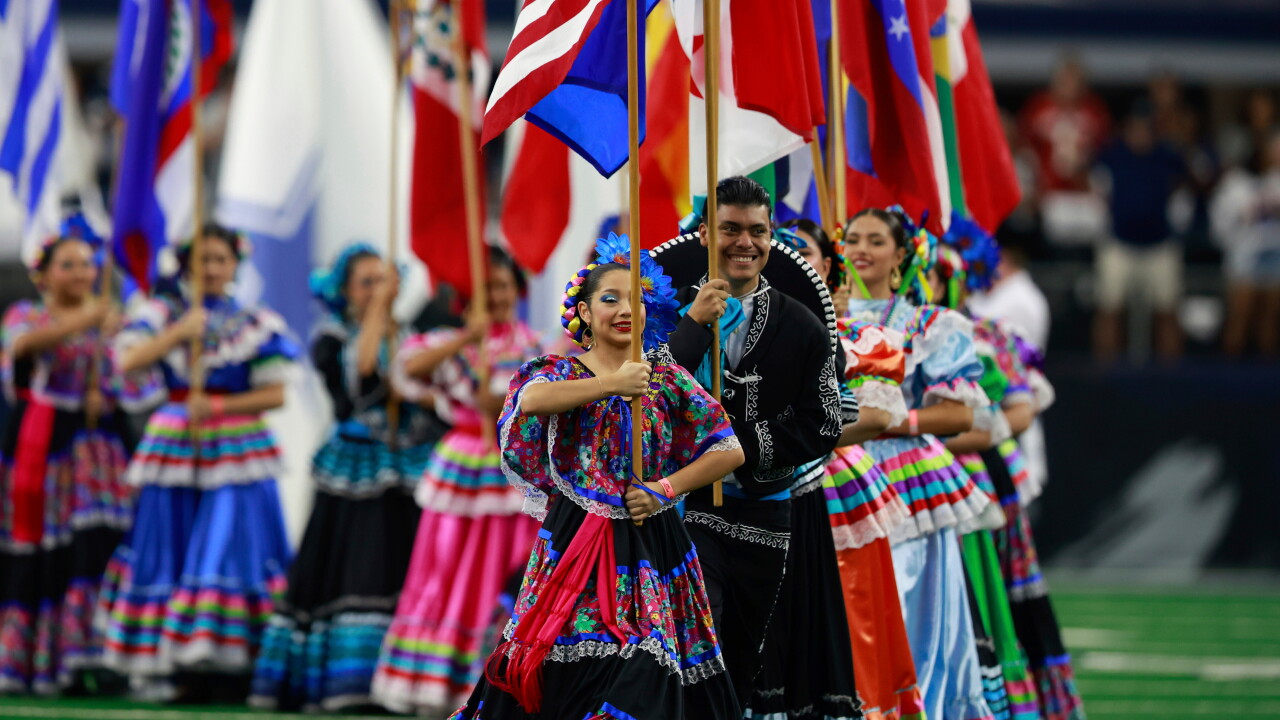

Celebrations across the U.S. are expected in observance of National Hispanic Heritage Month, showcasing the vast diversity and culture of Latinos.
Marked each year from Sept. 15 to Oct. 15, the month is an opportunity for many in the U.S. to learn about or be reminded of the contributions of Hispanic people. The nation's largest racial or ethnic minority, over 70 million ethnically Hispanic residents make up one-fifth of the total U.S. population, according to the census. The group includes people whose ancestors come from Spain, Mexico, the Caribbean and Central and South America.
Heritage month honors the cultures and legacy of Latinos
National Hispanic Heritage Month started as Hispanic Heritage Week. Mexican American U.S. Rep. Edward R. Roybal of Los Angeles created legislation for it and President Lyndon B. Johnson signed it into law in 1968.
It wasn't until two decades later that it expanded into a month under President Ronald Reagan.
"It was clustered around big celebrations for the community," said Alberto Lammers, director of communications at the UCLA Latino Policy and Politics Institute. "It became a chance for people to know Hispanic cultures, for Latinos to get to know a community better."
Sept. 15 was chosen as a tribute to the anniversary of "El Grito de Dolores," or the "Cry of Dolores," which was a call to battle issued in 1810 in Mexico's war for independence from Spain. Several Central American nations including El Salvador and Guatemala also celebrate their independence in September.
FROM THE ARCHIVES | Over 1 in 4 Americans will be Latino in a few decades, census projects
Labor movement ties into Latino observance
The festivities spotlight the interconnected struggles of Latin and Caribbean nations — including Costa Rica, Nicaragua, Guatemala, Honduras and El Salvador — and a history of fighting for the rights of Indigenous people, said Paul Ortiz, a professor of Latina/o labor history at Cornell University.
"The centrality of family, mutual aid, and community is very important to us because our parents, our grandparents, we've had to struggle to really make it in this country," said Ortiz, a former president of the United Faculty of Florida AFL-CIO union.
Coming from collectivist cultures is partly why Latinos join labor unions at a higher rate, he added.
"We understand the importance of collaboration, collective struggle in terms of improving wages and working conditions," Ortiz said.
With the U.S. Latino consumer base growing over the past decade, historians say there's an expanded curiosity and appreciation for the Latino community, especially during fraught political times. It also may be a time to reflect on the history of colonialism within Latin America.
"There are long trajectories of the racialization of people from Latin America in the U.S. but it's also the same contributions of these people who made the U.S. what it is," said Diego Javier Luis, a historian and assistant professor at Johns Hopkins University.
FROM THE ARCHIVES | Explaining the difference between Hispanic, Latino, Latina, Latinx, and Latine
Hispanic versus Latino label
The Hispanic label was created by the federal government for people from Spanish-speaking cultures. But for some, the identifier inherently carries political conservatism and emphasizes a connection to Spain. It sometimes gets mistakenly swapped with "Latino" or "Latinx."
Latino reflects ties to Latin America. So some will celebrate Hispanic Heritage Month as Latinx or Latin Heritage Month.
Latin Americans are not a monolith. From Mexican American to Colombian American to Salvadoran American, each culture in the diaspora has unique differences when it comes to food, art and music.
"The history of Latinos is U.S. history, Latino cultures are U.S. culture, Latino foods are U.S. foods, and our music is U.S. music," Luis said. "It's also about the people holding these communities together — the mothers, midwives, barbers, bodega owners, artists, poets."
