
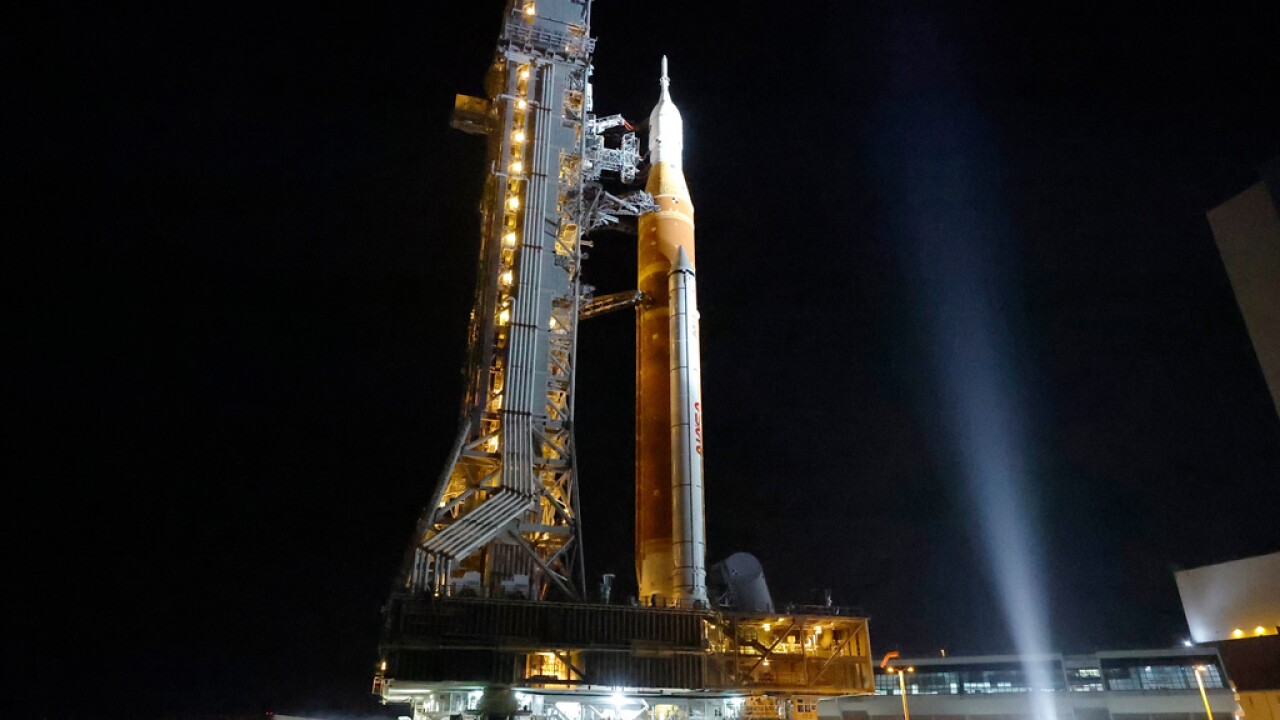


NASA’s Artemis II Space Launch System rocket and Orion spacecraft reached the launch pad at Kennedy Space Center on Friday morning as the agency prepares for humanity’s return to the moon.
The rocket and spacecraft returned to the pad nearly a month after a wet dress rehearsal flagged several issues, delaying the launch.
The rocket was moved about four miles from the Vehicle Assembly Building to the pad.
Last week, NASA said the crew could lift off as soon as April 1, with additional launch opportunities later that month. The astronauts began a two-week prelaunch quarantine Wednesday.
NASA astronauts Reid Wiseman, Victor Glover and Christina Koch, along with Canadian Space Agency astronaut Jeremy Hansen, will remain in isolation in Houston before flying to Florida five days ahead of the April 1 launch window.
RELATED STORY | Meteorite hunter travels to Ohio after meteor's sonic boom rattles houses
The latest delay came after engineers discovered an interrupted flow of helium to the rocket’s interim cryogenic propulsion stage. The mission had previously been postponed about four weeks after a rehearsal revealed a leak in Orion’s liquid hydrogen tank, which released excessive propellant into the rocket’s core stage.
Artemis I, launched in 2022, was the first mission in NASA’s Artemis program, which aims for deep space exploration beyond the moon. While Artemis I was uncrewed, Artemis II will carry four astronauts on a lunar flyby.
NASA initially planned for Artemis III to be the first crewed lunar landing, but the mission will now test an uncrewed lander. Artemis IV is set to be the program’s first crewed landing.
The last time NASA sent astronauts to the moon was Apollo 17 in 1972.
RELATED STORY | Scientists discover pungent sulfur planet beyond our solar system
