

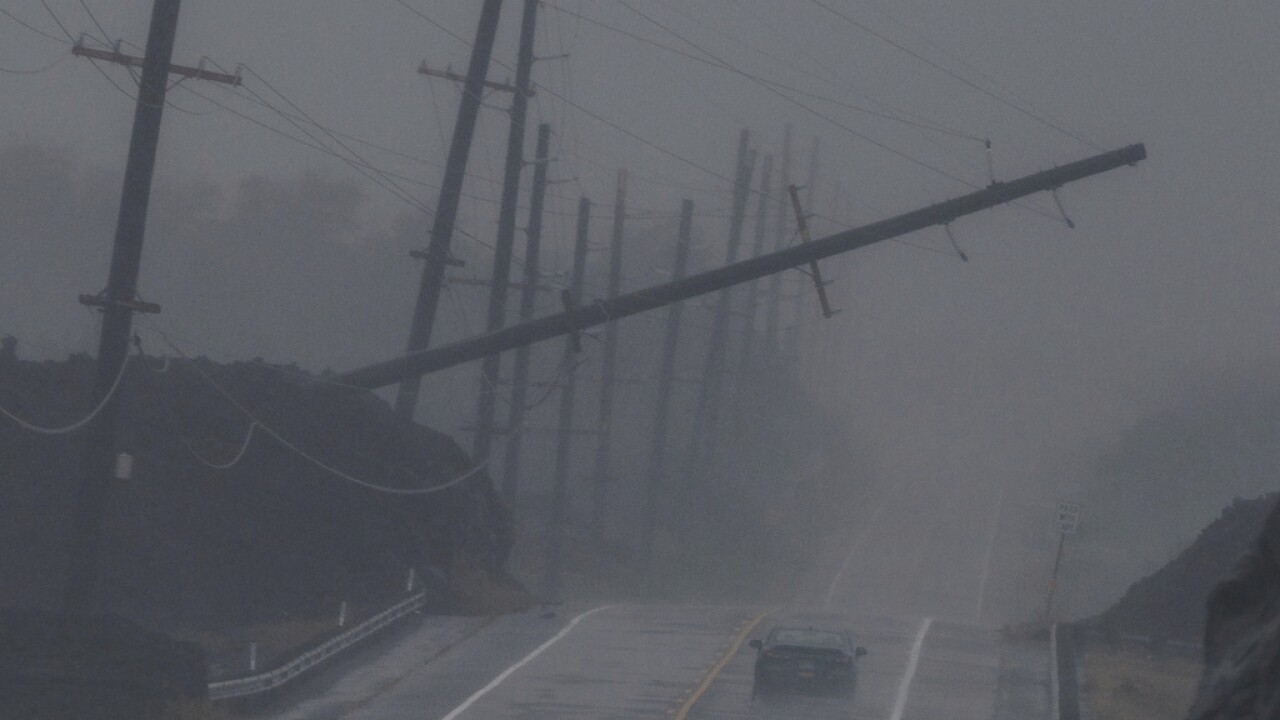

One person is dead and tens of thousands have lost power after Hurricane Lala lashed parts of Hawaii overnight, before weakening slightly Sunday morning to a tropical storm with 70 mph sustained winds and heavy rain.
At least 126,000 customers are without power across the islands. Nearly 70% of the Big Island is without power. Hurricane-force wind gusts were reported in Hawaii, Honolulu and Maui counties, with the mountainous island terrain amplifying winds at higher elevations.
Officials have issued a Flash Flood Emergency for Naalehu in Hawaii County, with the National Weather Service calling it a “Particularly Dangerous Situation.”
“Several occupied homes may have been swept off their foundations, and based on that, civil defense has initiated a search and rescue mission,” Hawaii County Mayor Kimo Alameda said overnight.
Lala was starting to pull away from the islands Sunday morning, but heavy rain is expected to continue throughout the day across the island chain.
One person was killed in a storm-related car accident, Hawaii Gov. Josh Green said Saturday evening, while at least 19 buildings had lost their roofs.
IN CASE YOU MISSED IT | Lala strengthens into hurricane as Hawaii’s Big Island braces for impact
In a video update Saturday night, Hawaii County’s Acting Civil Defense Administrator Darryl Oliviera said occupants of a vehicle stuck in floodwaters were being rescued, though he did not provide further details.
Lala, which strengthened to a Category 1 storm Saturday, made its closest approach to Hawaii’s Big Island at around 5 p.m. local time, with its eyewall brushing the southern portion from roughly 30 miles away, according to the National Hurricane Center (NHC).
The southern parts of the Big Island were expected to be hit the hardest by hurricane-force winds, which reached a maximum speed of 80 miles per hour when the storm was closest to the island.
Overnight, damaging winds and heavy rain are expected to persist across the Big Island and Maui County and spread westward across Oahu and Kauai County on Sunday, the NHC said.
Though Lala did not make landfall, its impact was still felt. Videos obtained by CNN show streets flooded by torrential rainfall on the Big Island, which got over 30 inches of rain.
More than 190 flights in and out of Hawaii have been postponed, Green said.
Emergency responders were expected to be busy dealing with urgent matters for 36 hours as the storm passed Hawaii, with damage assessment expected to begin on Monday, said the governor.
A record number of road closures and prolonged power outages had been reported, according to mayor Alameda.
As Lala moves northwest, its most serious threat is its torrential rain, which could also spur flash flooding across the other Hawaiian Islands. The National Hurricane Center warned of life-threatening flooding and mudslides, especially in steep terrain.
The storm was expected to dump more than a foot of rain on much of the Big Island, with isolated amounts over 2 feet possible. Over 12 inches of rain had already fallen in Keanakolu in the 24 hours to Saturday night. A foot of rain in Hilo would be more than a month’s worth of rain for the city.
Up to a foot of rain was also expected in parts of Maui, where tropical storm warnings are in effect. Lanai, Molokai, Oahu, Kauai and Kahoolawe are also under a tropical storm warning.
Waves could reach 8 to 12 feet, particularly on east-facing shores where a high surf advisory is in effect.
RELATED STORY | Hurricane forecast update: Is the government prepared for the rest of the season?
Lala’s current track has taken the center of the storm just south of the Big Island, but its strongest winds are north of the eye – putting them right over land. These winds can down trees and power lines, a risk exacerbated by rain-soaked soil that makes trees easier to topple.
As the storm passes by Hawaii, its circulation closer to the ground may wobble and deform as it runs into the mountainous terrain of Mauna Loa and Mauna Kea. This had presented a risk it could nudge the storm center onto land or keep it just offshore.
Landfalls — when the center of the eye moves over land — on the Hawaiian islands have happened only a handful of times in the modern record. The last tropical system to make landfall was Tropical Storm Olivia in 2018, which came ashore on Maui, the island’s first landfall since recordkeeping began in the 1950s.
The last landfalling hurricane was in 1992 when Category 4 Iniki hit Kauai, becoming the strongest storm to directly strike the state on record.
Lala could also push 1 to 3 feet of storm surge water onto normally dry ground along parts of the Big Island’s coast. Large, dangerous waves have reached east-facing shores and will build through the weekend, bringing life-threatening surf, rip currents, coastal flooding and significant beach erosion.
Hawaii residents brace for hurricane impacts
Across Hawaii, residents evacuated to designated shelters and scoured packed grocery stores as officials across several counties announced closures and prepared for potential landfall.
In Hilo, grocery stores and gas stations were busy as people stocked up on essentials, CNN affiliate Hawaii News Now reported. Hawaii County was also offering sandbags for residents around the island. Around 130 people had fled to shelters Saturday, according to the mayor.
“You got to take all the necessary precautions, right? So it’s batteries. It’s get your emergency kit, inform your neighbors, the kupuna (elders),” Mayor Alameda said earlier in the day. “Make sure that everybody’s safe because our island’s big and we have small communities and we’re very connected.”
Hawaii resident Maxine Totty-Hefley said living through the first hurricane in decades on the island is “really surreal” and described a mad dash at the grocery store Friday.
“Seeing people, like, rush through and getting their food and stock up on stuff. Like, lanterns were out, toilet paper was almost out,” she told CNN affiliate KITV.
Totty-Hefley was planning to evacuate to higher ground with her pets, she said.
“We are going to pack up all the dogs and the dog food and everything, take it to my mom’s friend’s house,” she told KITV.
Many roads in Hawaii County are closed due to downed trees and utility lines and landslides, according to the County of Hawaii Mayor’s Office.
“While road crews are working hard to clear debris as conditions allow, we need all residents and visitors to heed all warnings, move into safe shelter, and stay off the roadways,” Alameda said.
County officials and the National Guard had also been discussing placing resources ahead of time in areas hard-hit by storms earlier this year, according to Hawaii News Now.
And in Oahu, officials opened eight hurricane refuge areas as public facilities like the Honolulu Zoo shuttered.
Officials urged residents to be cautious as the hurricane approached.
“We also need our community to do its part by securing property, checking emergency supplies, staying informed, and avoiding unnecessary travel and outdoor activities as conditions deteriorate,” Kauai Mayor Derek S.K. Kawakami said.
In Maui, temporary evacuation points were opened as county facilities closed, events were canceled and first responders prepared for impacts.
Tropical storms approaching Hawaii typically hit cooler ocean temperatures before reaching the islands, but Lala will remain over warmer waters due to an ongoing marine heatwave that extends to California and a developing Super El Niño.
El Niño is helping fuel increased storm potential in the central Pacific this year with warmer ocean temperatures and weaker winds in the upper atmosphere, which can normally break up storms. The National Oceanic and Atmospheric Administration has forecast an above-average central Pacific season, with five to 13 cyclones expected.
The-CNN-Wire™ & © 2026 Cable News Network, Inc., a Warner Bros. Discovery Company. All rights reserved.
