

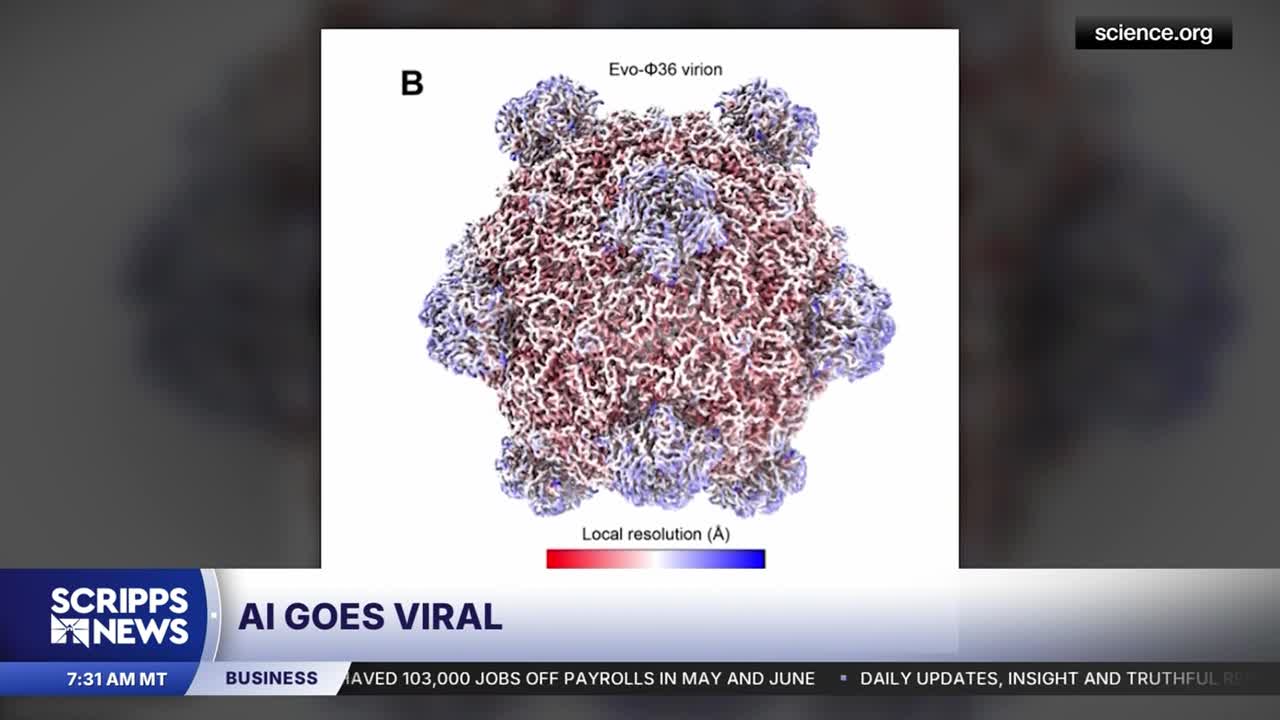


Scientists used an artificial intelligence program to create new viral genomes that are different from any known natural viruses and that targeted specific hosts, according to a new study.
The development is a hopeful step toward medical advances, but it also raises concerns around the potential for misuse.
The study, published Thursday in the journal Science, says that genetic sequences from millions of sources “from all domains of life” served as the language library for the AI tool Evo, much like ChatGPT and other language models are trained on large sets of existing text material.
RELATED STORY | An OpenAI test model escaped and broke into a real company’s servers
Scientists from Stanford University and the Arc Institute then used the AI to generate thousands of genome combinations within a specific framework – specifically one that could be hosted by an E. coli bacteria cell. Of the thousands of genomes that the AI generated, scientists built and tested about 300 in the lab and found that 16 were viable viruses.
The new viruses are bacteriophages, which infect bacteria but cannot affect humans.
According to the research, the genetic library helped the AI “learn the evolutionary constraints” of natural genomes, but the scientists found that one of the new viruses had an aspect that was “evolutionarily distant” — suggesting that the AI prompted changes that could have taken millions of years for natural evolution to show was possible.
Tests showed that a mixture of the new viruses could overcome antibacterial resistance in some of the E. coli strains, something that a “comparable mixture of naturally sourced” phages could not.
This “lays out a path for generating adaptive and resilient phage therapies against rapidly evolving pathogens,” the authors wrote.
It’s a notable scientific milestone, especially as scientists race to combat rising drug resistance within germs such as E. coli.
“The breakthrough achieved is significant,” Jordi García Ojalvo, professor of systems biology at the Pompeu Fabra University of Barcelona, said in a comment to the Science Media Centre.
But it doesn’t come without hesitation.
RELATED STORY | Nearly a third of college students use AI as part of daily life, study reveals
“Although this is promising for life sciences applications, it also raises urgent biosafety and biosecurity questions,” doctors from the Johns Hopkins Center for Health Security wrote in a corresponding article published in Science.
“The ability to compose viral genomes using generative AI now exists; the governance to safely steer it does not,” they wrote.
The researchers addressed the biosecurity considerations directly in their research — but the Johns Hopkins doctors wrote that they “engage with biosafety and biosecurity questions more deliberately than most developers of powerful biological AI models.”
The new research focused on E. coli bacteria and was in a certain type of virus that can’t affect humans – and it’s unclear how well the work would apply to other viruses.
But the authors of the response article single out one particularly risky area that they say should not be pursued: eukaryote-infecting pathogens, which can cause a variety of infections in humans, including malaria and certain yeast infections.
“Such genomes might encode new pathogens that can infect humans, animals, or plants in ways that cannot be contained by existing countermeasures,” they wrote.
García Ojalvo says the biosafety risk posed by the new research is lower than with some other AI tools, largely because the genomes have to be tested individually after they’re designed and the efficiency rate is low, with just 16 viable viruses from hundreds of thousands that were generated.
“It is difficult to imagine these models automatically generating viable genomes ‘out-of-the-box,’” he said.
The-CNN-Wire™ & © 2026 Cable News Network, Inc., a Warner Bros. Discovery Company. All rights reserved.
