

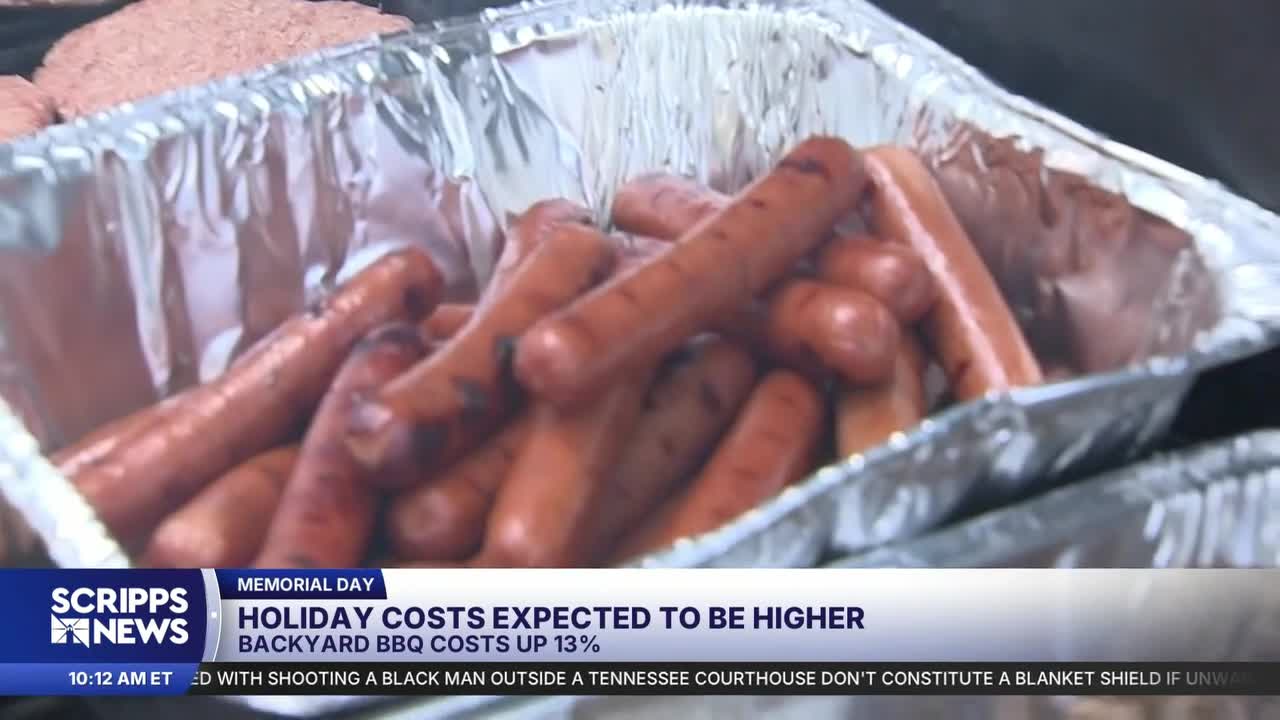


Staying home for Memorial Day weekend is still going to cost you this year.
That’s according to a new analysis shared exclusively with Scripps News that found barbecue staples like burgers, hot dogs and watermelon are up an average of 13% in 2026 compared to last year.
Some products have seen even greater increases; the average cost of six ears of yellow corn today is $5.90 compared to $2.97 last year, the analysis shows – a 98% increase.
The report from progressive think tanks The Century Foundation (TCF) and Groundwork Collaborative is just the latest data point documenting the rapid surge in prices impacting U.S. consumers since the Iran conflict began.
“Inflation is not just concentrated in these must-have meats. Consumers are going to see price hikes across the board at the grocery store,” Breyon Williams, chief economist at Groundwork Collaborative, told Scripps News in an interview. “It's way more expensive this year to host and to implement your traditional cookout than it was last year.”

Meanwhile, Americans seeking to travel over the long weekend will also see increased costs amid surging gas and diesel prices impacting both airfare and ground-based transportation options.
As of Wednesday, the average price of a gallon of regular, unleaded gasoline in the U.S. was $4.56, up $1.58 since the Iran war broke out. Forecasters have predicted costs will continue to climb until commercial traffic in the Strait of Hormuz returns to pre-war levels, and even then heightened prices could persist for several months.
“The economy is taking a bunch of hits from different places: we have the war in Iran which is causing gasoline prices to increase, but that is also trickling down to diesel prices,” explained Janelle Jones, senior fellow at TCF and former chief economist in the Dept. of Labor during the Biden administration.
“Most of the food in the US is actually moved around in trucks, and so diesel prices are going to drive a big increase,” Jones noted.
RELATED NEWS | Iran war drives energy price spike, wages struggle to keep up with inflation
Data released this month by the Bureau of Labor Statistics showed consumer prices in April were up 3.8% compared to a year ago, while producer prices – so-called wholesale inflation – was up 6% compared to 2025, the highest increase since late-2022.
The Trump administration has by and large brushed off concerns about the economic impact of the Iran conflict, suggesting price increases will be short-term and are well worth the cost in order to secure Americans’ safety from a nuclear Iran.
“President Trump has always been clear about temporary disruptions as a result of Operation Epic Fury,” White House spokesman Kush Desai told Scripps News in a statement in response to questions about the analysis. “The Trump administration remains laser-focused on delivering growth and affordability on the home front, with more announcements on other groceries to come, while working to eliminate the Iranian nuclear threat.”
A White House official went on to question the validity of the finding of the 13% average price increase, suggesting Bureau of Labor Statistics data showed a smaller increase. The Groundwork/TCF report relied on data from NielsenIQ, a global consumer intelligence company that provides retail and consumer data.
President Trump, meanwhile, has publicly and repeatedly stated that he is not concerned about Americans’ financial wellbeing when managing the Iran conflict.
Asked on May 12 to what extent Americans’ finances were motivating him to make a deal with Iran, Trump responded: “Not even a little bit.”
RELATED STORY | Trump on Iran talks: 'I don't think about Americans' financial situation'
“The only thing that matters when I’m talking about Iran – they can’t have a nuclear weapon. I don’t think about Americans’ financial situation. I don’t think about anybody,” he continued.
Trump doubled down on May 19; asked about rising gas prices, he said: “This is peanuts. And I appreciate everybody putting up with it for a little while, it won’t be much longer.”
Economists argue even short-term price increases were having a significant impact on Americans’ lives.
“These aren't, you know, once-in-a-generation things they're buying. These are things they need every day,” Jones said. “The pain is already there, and when families have already been dipping into their savings, they don't really have anywhere else to.”
Polls show inflation and the high cost of living remains Americans’ top concerns, as growing numbers of voters – even Republicans – are souring on Trump’s handling of the economy. About six-in-ten Republicans approve of how Trump is handling the economy, according to a poll from The Associated Press-NORC Center for Public Affairs Research released Wednesday. That's down from about eight-in-ten Republicans in February.
Just one third of Americans broadly approve of Trump’s handling of the economy, the same poll showed.
