


COLORADO RIVER, AZ — ABC15 is taking a closer look at the Colorado River as part of our continuing Running Dry coverage.
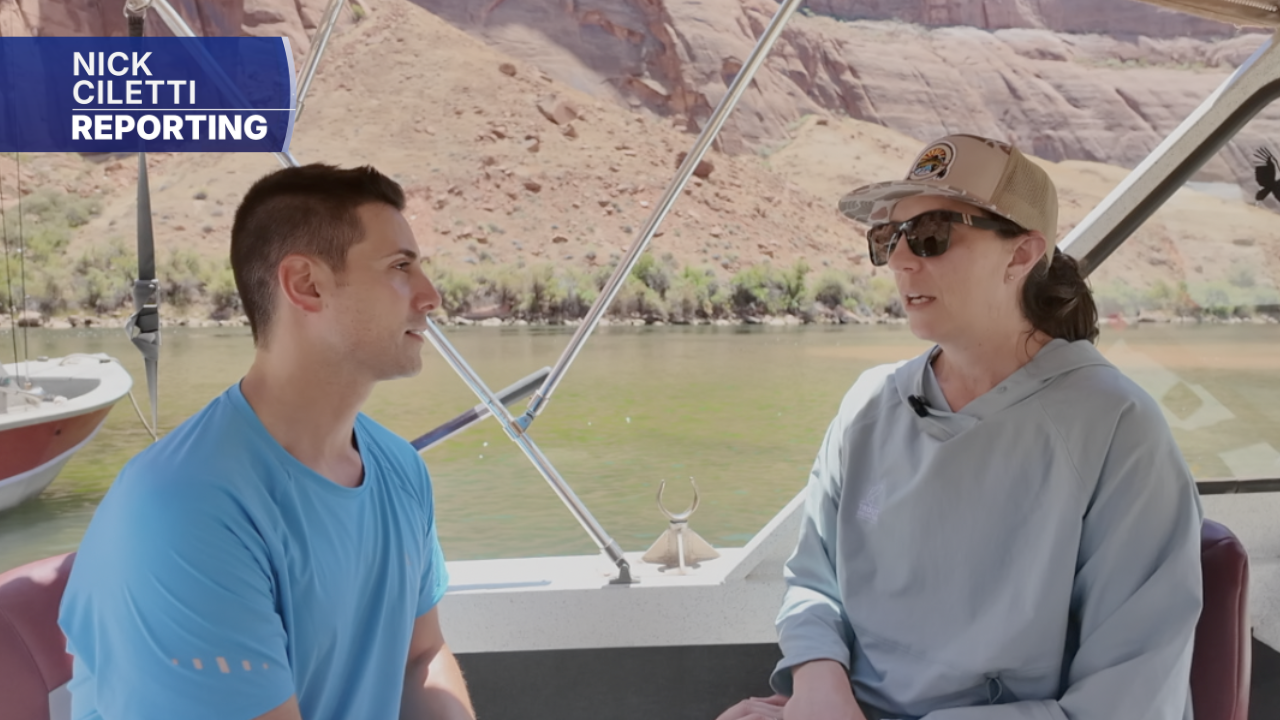
As Western states like Arizona wait for a new water-sharing agreement from the Department of the Interior, ABC15's Nick Ciletti went on a boating trip along the Colorado River recently in Northern Arizona, departing from Lee's Ferry up to the Glen Canyon Dam area.
Nick was the only TV reporter to travel alongside the nonprofit group Trout Unlimited, which spearheads a number of conservation and restoration projects across Arizona and in other states.
State of the river
It is a waterway as stunning as it is delicate - a lifeline for some 40 million people in communities across the Valley, across Arizona, and across much of the West - from tribal communities to sprawling megacities like Phoenix.
We recently got to see the current state of the Colorado River up close in Northern Arizona - and it wasn't hard to spot certain areas where the water levels appeared to be dangerously low.
Dr. Porterfield is a leading expert on the history of the Colorado River and works as Trout Unlimited's Colorado River Program Director & Western Water Policy Advisor.
"It's the climate we are in," explains Dr. Porterfield. "These big empty buckets that we've got: Lake Mead and Lake Powell, and there's not a lot of water in those."
On the boat, we began the day at Lee's Ferry, then traveled upstream to the south side of the Glen Canyon Dam. On the other side of the Dam is Lake Powell.
As of a last check on June 24, according to the U.S. Geological Survey, water levels are about 35 feet lower right now than they were this time last year. Also, Lake Powell is only at about 23% capacity - and one very noticeable place is at the Glen Canyon Dam, with officials having to decrease the frequency of water releases since levels in the reservoir have remained low.
Lake Powell is inching dangerously close to what's called "the minimum power pool level," with concerns that the water levels could dip below the critical 3,490-feet mark, saying back in April: "If Glen Canyon Dam declines below 3,490 feet, water releases would be only through the river outlet works, which could cause operational issues, uncertainty for users, downstream impacts, instability in regional power and water supplies, and a reduction in power generation."
To help improve levels, the Bureau of Reclamation announced in the spring that a plan was underway to move water from the Flaming Gorge Reservoir near the Utah-Wyoming border. Officials say as much as a million acre-feet could be transferred by April 2027. To read more about the plan,
click here."We had a really dry Winter in the west this year," explains Dr. Porterfield. "We didn't get a runoff season or a ton of runoff from snowpack, and that's on top of this 20-year drought and climate change."

And it's not just that area in and around the Glen Canyon Dam. According to the Bureau of Reclamation, our drought has reduced storage throughout the Colorado River to just 36%.
However, Porterfield says there is still hope, especially if all of us take action and do our part.
"It's things like watershed health projects like we work on across the basin," she says. "It's flexible, voluntary compensated water conservation programs, it's water recycling and reuse programs where that makes sense. There is a whole host of solutions that together need to be funded, and need to be scaled up, and they are there. We can do this."
The economic impact of the Colorado River
With a backyard that has some of the best views in Arizona, it's easy to see why Valley native Brady Black loves living in the Marble Canyon area in Coconino County.
"I love waking up here every day," says Black. "And I count my lucky stars every day."
Black has also owned the Lees Ferry Lodge at Vermillion Cliffs for eight years - a quaint motel, bar, and restaurant with a front row seat to some of State 48's most breathtaking scenery.
It has easy access to the Lees Ferry Boat Launch, just 15 minutes down the road. But with concerns about the Colorado River and surrounding reservoirs drying up, Black worries the opportunities could be drying up as well.
"It's top priority for us. It's everything in this area."
The Colorado River isn't just an environmental lifeline; it's also an economic one. According to a number of studies, the Colorado River generates $1.4 trillion in total economic activity every single year.
Places like the Lees Ferry Lodge serve as a resting spot for folks enjoying activities along the Colorado.
"The river industry is pretty big for us," explains Black. "And as the water goes down, we see less travelers...The hotel business, especially one as small as us, has very little profit margin, and it's tough just to start with."
Just across the border in Utah, they're already seeing the impacts on Lake Powell. Our Scripps News Group Salt Lake City team was there in May when a number of boats, and even an entire marina, were beginning to be towed away to an area that had deeper water.
Even though Black says that where he lives is paradise, the price of paradise for small business owners like him continues to rise, partly because of the water situation.
Black hopes states can still come together to find ways to not only share water in the future, but also find ways to conserve the water we already have.
"We all need to do the right thing and quit the me-first politics," he explains.
Recently, we followed up with the Department of the Interior to see if there's a better timeline for when the federal government could release its plan on how states will divide up water from the Colorado River. We were not given an exact timeline, but were told it could be soon. Count on ABC15 to continue following up.
Colorado River wildlife impacted by water shortage
As we brace for cuts to Arizona's Colorado River water allocation, we can't forget that it's not just us humans who are affected.
There is a huge environmental impact - already underway up and down the Colorado River - but the good news is, there are ways all of us can help out.
"We are in one of the most scenic places you can fish in the state," says Alec Young, an Arizona native, avid angler, and also a conservationist with Trout Unlimited. He specializes in fish and habitat preservation.
People come from all over the world to fish in the legendary waters of the Colorado River; even for an Arizona native like Young, the scenery never gets old!
"There will be times today when I'm supposed to be looking at my indicator, and I'll be looking at the canyon walls!" he explains.
Last week, when we traveled along the Colorado River in northern Arizona, starting at Lees Ferry and cruising up to Glen Canyon Dam, we saw just how low the water levels had gotten.
"Many states just had record-low snowpack," says Young. "As we get into these warmer months, we are seeing the trickle-down effect of that."
And that includes having a lower water table, fewer releases from the Glen Canyon Dam, and lower levels in our reservoirs.
"Less water availability means less habitat available because of receding waters. What concerns me the most is the lack of water."
More than 40 million people depend on the Colorado River, but "wildlife is feeling the effects just as much as us," says Young.
The Colorado River is home to more than 150 endangered or threatened species - not to mention hundreds of other species of animals and plants whose habitat is being threatened more and more each day.
But Trout Unlimited is trying to change that with a number of restoration projects throughout the Colorado River Basin.
For example, in Eastern Arizona, the Thompson Burro Meadow Restoration Project in the Apache-Sitgreaves National Forest is working to restore wet meadows and streams, many of which were damaged in the Wallow Fire back in 2011.
Less than a year into the project, Trout Unlimited says they are already seeing results.

"The water table is rising," explains Nathan Rees, the head of Trout Unlimited here in Arizona. "We are proving that this restoration work, even in a really dry year, is having a direct effect on re-wetting the sponge."
It’s a reminder that there is still hope as long as all of us are willing to help out and do our part.
To learn more about easy ways we can all start saving water at home right now, click here.
To learn more about Trout Unlimited and the work they are doing, click here.
Want more news in your community? Add ABC15 as a preferred source on Google below: