
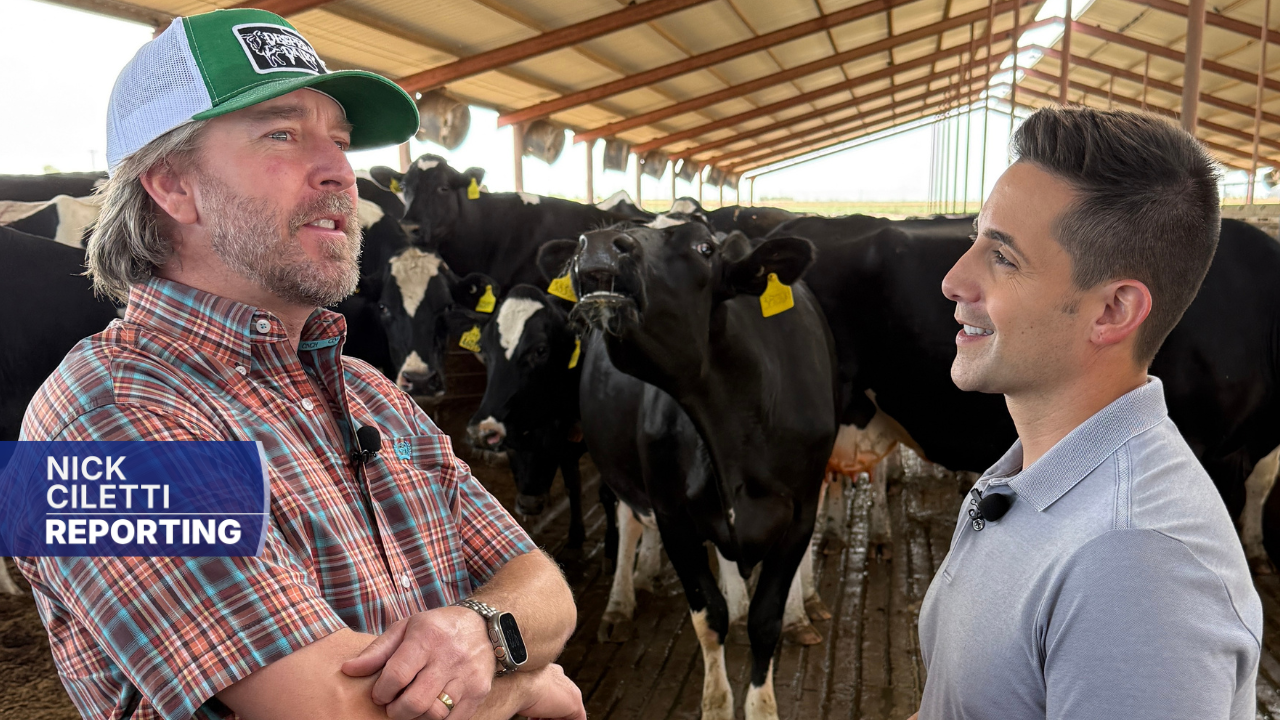


CASA GRANDE, AZ — Dairy farming has been a part of Arizona's agriculture for generations, with 200,000 milking cows currently in the state. It's an industry that generates more than a billion dollars every single year across Arizona.
Recently, ABC15's Nick Ciletti went to Casa Grande to speak with Casey Dugan, a fourth-generation dairy farmer who owns and operates Desperado Dairy, which he and his wife, Andrea, opened in 2010.
You'll find all shapes, sizes, and colors at Desperado Dairy in Casa Grande. We even got the chance to meet a calf who had been born that week - at a whopping 90 pounds! But that's nowhere near the size of the mothers, who typically weigh in around 1,500 pounds.
And those mother cows are providing both the milk — and the money.
According to the Arizona Farm Bureau, a typical milking cow can provide about 10 gallons of milk per day - and it adds up. Across the state, the Farm Bureau says Arizona's dairy industry brings in $1.2 billion in cash receipts annually.

"Arizona dairy farms are still producing good milk," explains Dugan. "I drink milk every day. Even my dog drinks milk!"
For Dugan, it is clear: dairy farming is his passion.
"When you're away, you miss the cows, you miss the job, you miss the dairy, you miss the people you work with. It's a very special industry."
But it's also a challenging one as many farmers across the state and across the nation struggle with a variety of issues, especially when it comes to costs.
"It doesn't matter what you get paid; you have to continue to feed the cows and milk the cows. That's why the industry is tough sometimes."
Dugan says that at times, it makes him and other dairy farmers consider closing or minimizing their operations.
"We have had tough years," he says. "Milk prices don't really change. But the cost to produce is always changing. The feed cost goes up and down. Fuel costs go up and down. It doesn't matter. We have to make sure we feed the cows the same product. We are only making money every five years."
Take fuel, for example. Dugan explains it costs about double what it used to.
"Our fuel costs used to be about $15,000 a month, but now it's about $30,000."

Despite the challenges, he says all the rewards that come with it make it all worth it.
"The lifestyle, the animals, and every day is different," Dugan explains. "You know they need care. And you're providing a good quality product for our families and for the United States and the world."
Here in Arizona, almost all of our dairy farms are family-owned businesses, including some dating back multiple generations.
To learn more about Arizona's dairy industry, click here.