

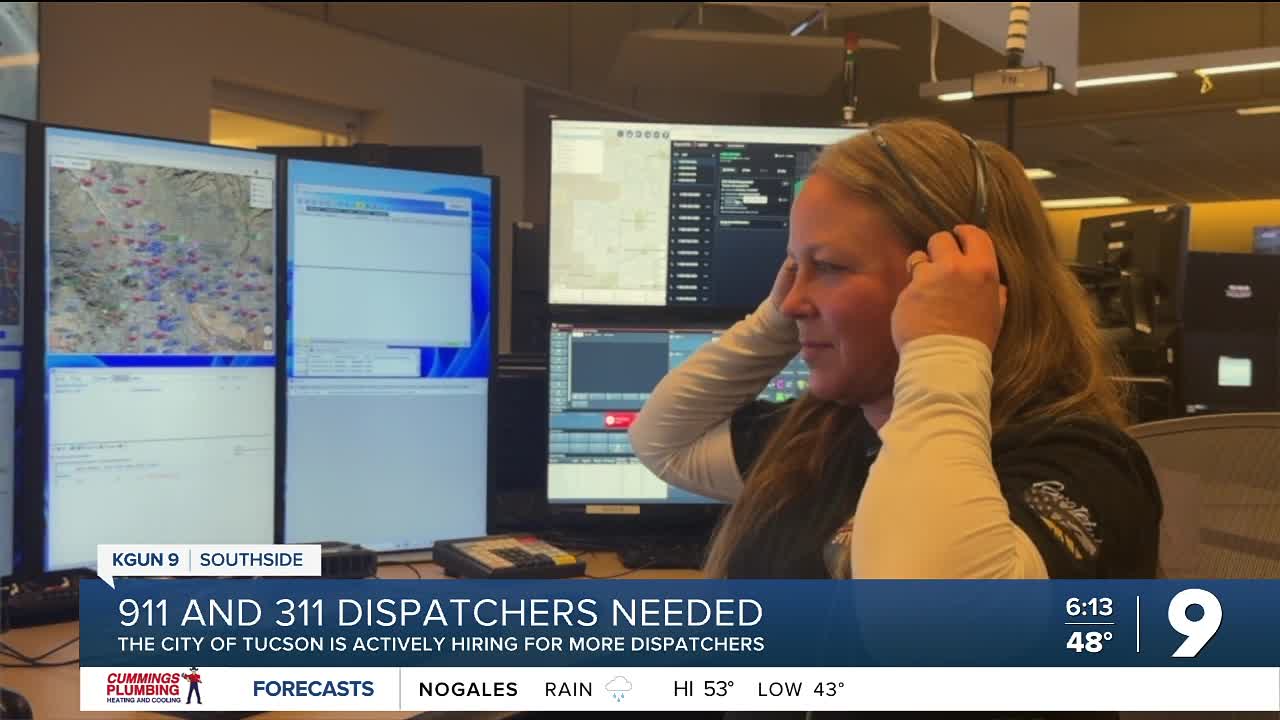


TUCSON, Ariz. (KGUN) — The City of Tucson is actively hiring more 911 and 311 dispatchers as demand continues to rise.
For nearly three decades, Paige Heath has been one of the steady voices answering those calls.
“I take police, fire, and EMS calls,” Heath says.
Over the years, she’s handled everything from joyful moments to emergencies.
“You might deliver a baby, you know, and be celebrating with that person on the phone, and then the next call you might take could be a multiple shooting. So it does go from, you know, the good, the bad of everyday life,” Heath says.

Richard Pegues, the city’s support services administrator, said the dispatch center is still operating below ideal levels.
“In a perfect world, we have roughly six police dispatchers and six fire dispatchers on duty at any given time, generally we have four or five of each, so we are trying to get more,” Pegues explains.
Pegues says the work is demanding and not suited for everyone who applies.
“This isn't a job that you're gonna do to get rich. It's, you do it for you because you love it. You do it because you want to give back to the community,” he says.
To help dispatchers cope with the emotional toll of the job, Pegues said a clinician works on-site to support staff when calls become overwhelming.
“Our call takers take 100 calls roughly in a 12-hour shift. That's an opportunity to impact 100 people's lives who are having a rough day,” he says.
In 2025, the city hired 48 new dispatchers. Pegues said 34 of them are still working at the center today, while about 20% left due to emotional triggers tied to the work.
Despite staffing shortages, the department continues to meet response benchmarks. Pegues said about 71% of calls last year were answered within the 20-second standard.
“People can feel safe that when they do call 911, the vast majority of cases, their call will get answered inside of 20 seconds but that is also why we’re hiring to get more people in the seats. The more people I have, the faster that we can answer the phone,” Pegues says.
City data shows the average wait time for a primary, life-threatening 911 call was 13 seconds from January through November of 2025. For 311 calls, the average wait time was 52 seconds.
Secondary lines are calls that are placed but triaged as non life-threatening, so they are transferred here for processing. The average wait time for primary and secondary calls combined is 24 seconds, according to data.
For Heath, watching Tucson grow has only strengthened her commitment to the job.
“There's only been a few calls in the 27 years that have hit home with me, but you just learn to keep stuff separate and come back for your next shift,” she says.
To become a 911 operator, applicants must complete 20 weeks of training. Starting pay is about $19.97 an hour.
To become a 311 operator, training takes about eight weeks to complete. Starting pay is about $18.00 an hour.
Applicants must be at least 18 years old, have a high school diploma and be able to type at least 35 words per minute.
———
Athena Kehoe is a reporter for KGUN 9, she joined the KGUN 9 team in July of 2024 after graduating from Arizona State University. Share your story ideas with Athena by emailing athena.kehoe@kgun9.com or by connecting on X/Twitter.

----
STAY IN TOUCH WITH US ANYTIME, ANYWHERE


