

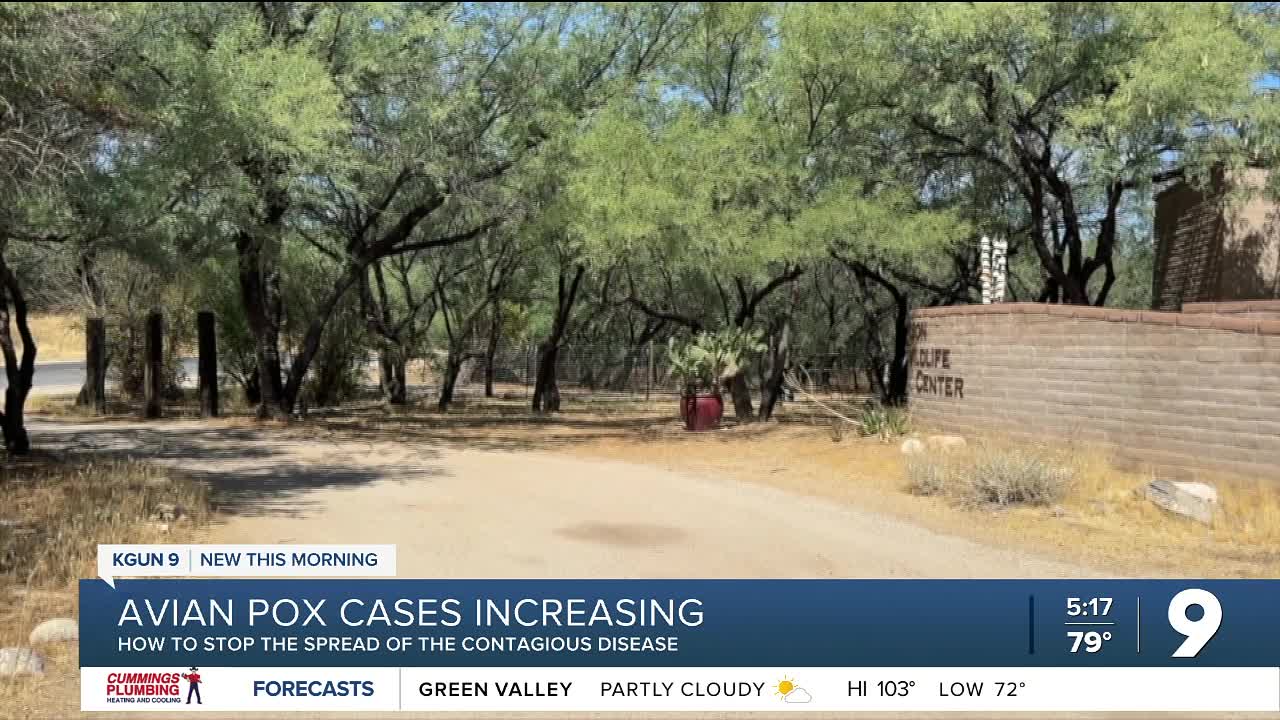



TUCSON, Ariz. (KGUN) — The Tucson Wildlife Center is reminding people to regularly clean backyard bird feeders and birdbaths as it continues treating birds with avian pox, a contagious virus that affects birds.
The center said this time of year brings an increase in certain diseases. Just a few weeks ago, it was treating 10 birds for avian pox. That number has since dropped to six.

"Avian pox is a virus that birds can get. Very contagious, there's a wet and dry," said Hubert Parker, development director for the Tucson Wildlife Center.
According to the center, the dry form of avian pox causes wart-like skin lesions, often on a bird's legs, around the eyes, or near the base of the beak. While treatable, recovery can take a long time.
The wet form affects the mouth and throat, where lesions can make it difficult for birds to eat or breathe. The center said those cases are much more serious and often have a poor prognosis.
Parker said the virus is more common during the summer.
"This time of year, it's more seasonal when it's hot and humid, and a lot of times they're spread by mosquitoes," Parker said.
While it spreads easily among birds, it is not transmissible to humans or pets.
The center recommends cleaning bird feeders and birdbaths at least twice a week during the summer to help prevent the virus from spreading. Parker also said homeowners with multiple feeders should spread them apart to keep birds from gathering in one place.
Sharif Khan, a rehabilitation specialist at the Tucson Wildlife Center, said most birds with avian pox are not showing symptoms when they arrive at the center.
"It's not something that you can vaccinate for easily. It's very high cost to vaccinate every bird that comes through, so instead we just monitor for symptoms," Khan said.

Birds that develop symptoms are placed in quarantine for as long as needed while they receive care.
"We come in at the end of the day, we provide food, water, all of our diets are specific for the species that are in there. So for example, currently it's mostly doves. Doves are what we call granivores, which means they eat seeds primarily. So we provide a seed-based diet," Khan said.
The center said avian pox can remain on surfaces, making sanitation an important part of preventing the disease from spreading.

The Tucson Wildlife Center is the only wildlife rescue hospital in Southern Arizona. Anyone who sees wildlife they believe needs to be rescued can call the center at 520-290-9453.
———
Athena Kehoe is a reporter for KGUN 9, she joined the KGUN 9 team in July of 2024 after graduating from Arizona State University. Share your story ideas with Athena by emailing athena.kehoe@kgun9.com or by connecting on X/Twitter.

----
STAY IN TOUCH WITH US ANYTIME, ANYWHERE


