

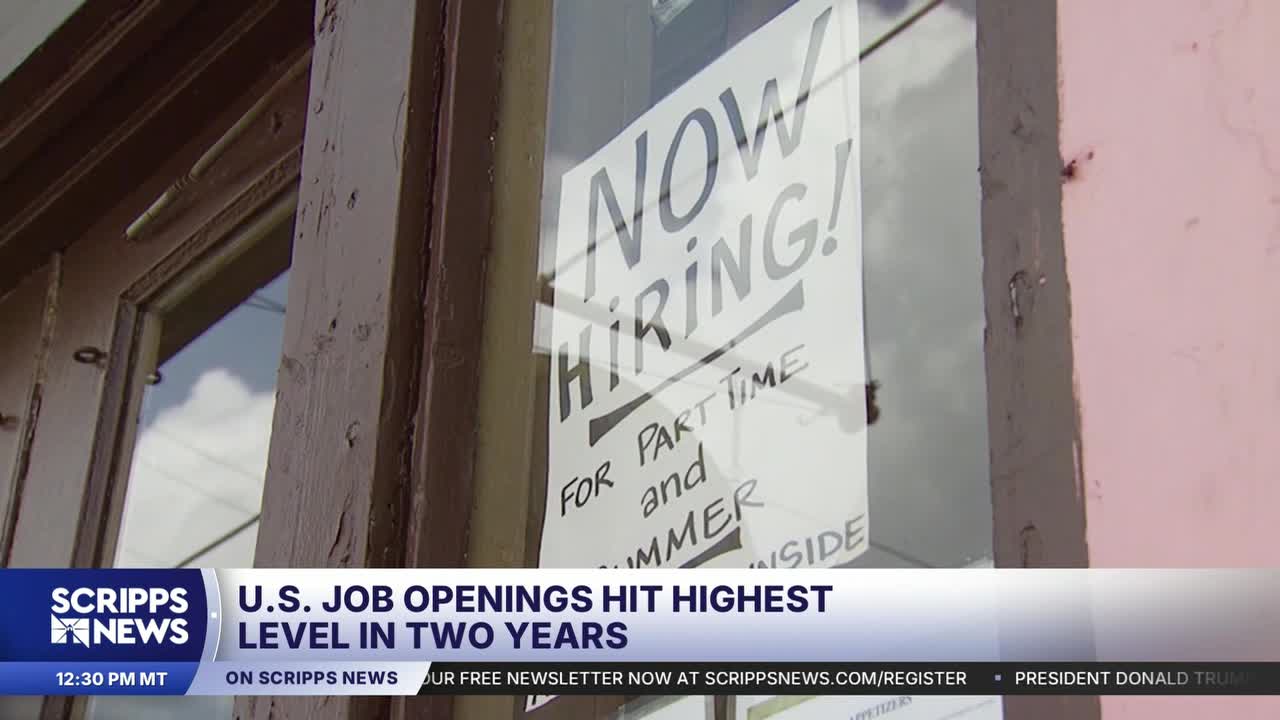


U.S. businesses are brushing off those “Now Hiring” signs: Job openings rose sharply in April to their highest level in nearly two years, Bureau of Labor Statistics data showed Tuesday.
However, the latest look at labor turnover also showed that those job postings aren’t necessarily turning into job offers – the U.S. job market remains entrenched in a low-hire, low-fire dynamic.
The number of available jobs jumped to an estimated 7.62 million positions at the end of April, increasing from 6.89 million in March and bucking a two-month decline, the latest Job Openings and Labor Turnover Survey showed.
At the same time, the number of new hires and layoffs both tumbled after bolting higher in March; and voluntary quits fell to their lowest level in nearly six years, an indication of workers’ slipping confidence in the labor market.
RELATED STORY | Teen summer jobs are getting harder to find, but some companies are stepping in
The imbalance between employers’ wish lists and their payrolls can be partly attributed to rising labor costs and broader economic uncertainty, Noah Yosif, chief economist at the American Staffing Association, told CNN in an interview.
“Miscalculating on the wrong worker can be costly for employers, and so employers are really taking their time to make sure they are filling jobs with the right candidates,” he said.
A potentially heartening signal
First, a level-set: Monthly data can be immensely volatile, and April’s data could be revised when the May JOLTS rolls around. Plus, JOLTS and other economic reports have been dogged by low survey response rates.
If Tuesday’s data, particularly the spike in job openings, doesn’t turn out to be a blip, it could indicate that the U.S. labor market not only is stabilizing but also possibly expanding.
For the first time since last June, there are more job openings than job seekers.
“It’s an important milestone to give job seekers hope,” said Heather Long, chief economist at Navy Federal Credit Union.
This could all be welcome news for white-collar workers whose industries have been in contraction, as well as for those who fear the AI axe will fall on them.
More than 90% of the increase in April job openings was in the professional and business services industry, BLS data showed.
“Granted, one report doesn’t make a trend … but it definitely pushes back on that narrative that we’ve been worrying about for quite a while, which is that artificial intelligence is going to be the great job-killer,” Yosif said. “Employers are finding ways to involve humans even though responsibilities are likely going to continue to shift as these technologies permeate within the labor market.”
War effects loom large
The surge in white-collar job openings also would be a welcome sign for college graduates, noted Bill Adams, chief U.S. economist for Fifth Third Commercial Bank in Dallas.
“On balance, April’s jump in openings is an encouraging sign for job seekers finishing school this year but shouldn’t carry disproportionate weight to other job market indicators,” he wrote in a note to investors. “The collective message from recent job market data is that U.S. employment is growing modestly, but nevertheless at a faster pace than that of job seekers.”
IN CASE YOU MISSED IT | Young and unemployed? Remote work, not AI, may be the problem, study finds
The labor market churn – the inflow and outflow of workers – has slowed significantly in the past two years due to a confluence of dynamics, including the aging (and retiring) of workers, a post-pandemic hiring normalization, the emergence of new technologies, increasing economic uncertainty and sharp reductions in immigration.
Economists have cautioned that the U.S.-Israeli war with Iran and the related oil and supply shock could suppress hiring activity in the United States.
That remains the case, Yosif said, noting that the US tapping into its strategic reserves has helped to blunt the effect of war’s oil supply crunch.
“There has also been a lot of push on both the United States’ side as well as Iran’s side to portray that both sides are working toward a deal, but that status quo cannot be held long term,” he said. “Eventually oil supplies are going to run out. Eventually, investors are going to be expecting something more concrete with respect to when the Strait of Hormuz is going to be open.”
He added: “And I think that is where we could actually see some reversal in the (job) gains that we’ve seen at the beginning of this year.”
The-CNN-Wire™ & © 2026 Cable News Network, Inc., a Warner Bros. Discovery Company. All rights reserved.
